New vet clinic marketing in 2026 comes down to four deadlines inside a 180-day window. Get on Google 90 days before opening, reach about 20 recent reviews in the 90 days after, answer every call, and book each patient's second visit. Ohio State researchers booked on only 67% of calls to vet practices in 2025, mostly because callers never reached staff.
What should new vet clinic marketing focus on first?
New vet clinic marketing should focus on four jobs, each with a deadline: be visible on Google 90 days before opening, reach about 20 recent Google reviews within 90 days of opening, answer every call from the day the phone number goes public, and book each new patient's second visit before the first one ends. The logo, the open house and the mailers all come after those four.
The four jobs matter because a new clinic's first clients are pet owners who are already looking for a vet, not loyal clients pried away from an established practice. Those owners search, read reviews and call. Ohio State University researchers posing as dog owners booked an appointment on only 67% of calls to more than 5,000 veterinary practices in early 2025, and most failed calls never reached staff or sat on hold for more than five minutes.1
The table puts each job next to its deadline.
| Job | Why it decides year one | Deadline |
|---|---|---|
| Be on Google before opening | Owners who move or switch vets search before they call | 90 days before opening |
| Reach about 20 recent reviews | Many owners pass over a clinic with only a handful | 90 days after opening |
| Answer every call | Unanswered calls lose more bookings than full schedules | The day the number goes public |
| Book the second visit | Every patient a new clinic has is a new patient | Before each first visit ends |
The 180 days from 90 days before opening to 90 days after are the window this guide covers, because Google treats a new clinic differently during them. If you are still settling on the kind of clinic you are opening, our guide to veterinary marketing strategy by clinic type sets new clinics beside urgent care, wellness and five-day practices.
Where do a new vet clinic's first clients come from?
A new vet clinic's first clients come from three groups of pet owners who need a vet now: people who have just moved, people ready to leave their current clinic, and people with a new puppy or kitten. Owners who are happy with their current vet have little reason to switch just because a new clinic opened nearby, so launch marketing works best when it is aimed at owners who are already searching.
Movers are the steadiest pool. The US Census Bureau's American Community Survey found that 11.6% of people moved to a different home in 2025, and 9.0% moved within the same state.2 Every one of those households with a pet may need a vet nearer the new home.
Switchers are the second pool. PetDesk's 2025 Pet Parent Research Report, a survey of 1,000 North American pet owners, found 31% said they were likely to switch veterinary clinics in 2025, rising to 40% among younger owners.3 Half reported problems booking appointments.3 They are looking for a clinic that is easier to reach, and on day one that is the one advantage a new clinic has.
New pets are the smallest pool, and it is shrinking. Vetsource data presented at the AVMA's 2026 Veterinary Business and Economic Forum put new puppies and kittens at about 10% of a typical patient base, with new puppy visits down 12.0% and new kitten visits down 2.1% year over year.4 Puppy and kitten packages are worth offering. They are not a launch plan on their own.
| Pool | When they look | What reaches them |
|---|---|---|
| Owners who just moved | In the weeks after the move, often before the pet needs care | Google Maps, a complete profile, online booking |
| Owners ready to switch | After a booking problem, a long hold or a price shock | Appointments this week, a phone that gets answered, published prices |
| Owners with a new pet | Before the first vaccines are due | Puppy and kitten pages, Meta Ads to nearby households |
The client a new clinic struggles to win is the happy one at the practice down the road. An open house will not move them, and there is no need to try in year one.
What can a new vet clinic do on Google before it opens?
A new vet clinic can create its Google Business Profile up to a year before opening, enter a future opening date and verify the profile, which then appears on Google 90 days before the opening date. During those 90 days the clinic can post updates, add photos and write its description, but nobody else can leave a review until the clinic officially opens, according to Google's help page on opening dates.5
Once the doors open, Google shows a "Recently opened" tag on the profile for 90 days.5 Those two 90-day windows are the 180 days in this guide's title, and they are the only time Google treats a clinic as new.
A pre-opening sequence that fits most new clinics:
- Settle the clinic's name, address and phone number, and write them the same way on the website, the profile and every directory.
- Create the Google Business Profile, enter the future opening date and finish verification well before the 90-day mark.
- Launch the website with services, hours, the opening date and a booking link, so the profile has somewhere to send people.
- From the 90-day mark, post construction photos, team introductions and the opening date to the profile.
- Open online booking for the first weeks, so owners who find the profile can act on it straight away.
- On opening day, confirm the profile shows the clinic as open and start asking every client for a review.
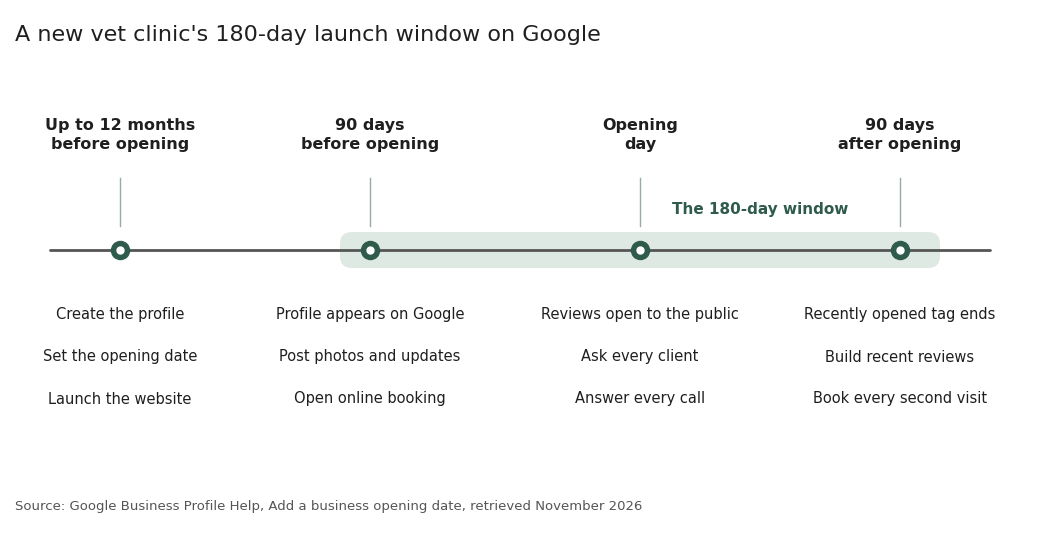
Google lets a new clinic appear 90 days before opening and tags it as recently opened for 90 days after.
The hard part is ranking. Google describes prominence, one of its local ranking factors, as how well-known a business is, judged partly by how many websites link to it and how many reviews it has, and says there is no way to request or pay for a better local ranking.6 A new clinic starts with almost none of either. What it controls on day one is completeness: every service listed, the right primary category, real hours and real photos.
Consistent details everywhere from week one matter beyond Google, too, because ChatGPT may draw on other sources when it answers questions about a business.7
Do people prefer ChatGPT or Google when choosing a local business?
Most people still prefer Google when choosing a local business, and more of them now use ChatGPT alongside it rather than instead of it. BrightLocal's July 2026 survey of 1,227 US consumers found 61% started their most recent local business search on Google Search or Google Maps. Of those who started on an AI tool, just 2% used it as their only channel, and 43% went on to check Google.8
AI use is still climbing fast. Pew Research Center's 2026 survey of 5,119 US adults found 49% use AI chatbots, up from 33% in 2024, and 42% use them to search for information.9 ChatGPT is the one most people use, at 44% of US adults, up from 34% a year earlier.9
Local recommendations are part of that shift. BrightLocal's 2026 review survey found use of ChatGPT and similar tools for local business recommendations rose from 6% to 45% in a year.10 No published survey yet isolates pet owners, so read these as figures for local shoppers in general.
Trust has not caught up with use. Among consumers in BrightLocal's July survey who used AI for a local search, only 18% felt ready to contact the business an AI tool recommended; the rest kept checking Google and other channels.8 For a new vet clinic, that means a ChatGPT mention often ends with the owner checking the Google profile and reviews before calling.
The AI is inside Google too. Pew found 60% of US adults read the AI summaries at the top of search results.9 In Pew's 2025 browsing study, Google users clicked a traditional search result on 8% of visits when an AI summary appeared, against 15% when one did not.11 More of the decision now happens on the results page and the profile, before an owner ever opens the clinic's website.
What is ChatGPT Business Hub, and can a new vet clinic use it?
ChatGPT Business Hub is the OpenAI tool, launched in beta on November 10, 2026, that lets a business claim its listing in ChatGPT, update its details and see how often ChatGPT mentions it. A new vet clinic can use it with one catch: in the US, local businesses can currently claim only a listing ChatGPT already has, and cannot add a new one, according to OpenAI's help center.7
The audience is large. OpenAI's announcement puts ChatGPT at 1.2 billion weekly users, and says that when a business appears in an answer, people can click through to its ChatGPT profile, the listing Business Hub controls.12
How a new vet clinic claims its ChatGPT listing:
- Sign in to ChatGPT, open Business Hub from the sidebar and search for the clinic by name.
- Select the matching listing and verify with whichever method it offers: business phone, business email or a DNS record on the clinic's website domain.
- Complete Persona identity verification, which can ask for government ID, business registration and proof you can represent the clinic, using the legal name on the registration documents.
- Update the website, description, service category, logo and cover photo, and keep them matching the Google profile.
- If no listing exists yet, check again after opening, and keep the clinic's name, address and phone identical everywhere in the meantime.
Once verified, Business Hub reports 28 days of mentions, website clicks and discovery topics. For a local business, a mention counts whenever ChatGPT shows a result for that location, even if nobody opens it.7 Claim it from a clinic-owned account: the admin who claims the business can add teammates and grant an agency access, the same owner-first setup that matters on Google.7
The inconvenient part: claiming does not buy visibility. OpenAI says claiming doesn't guarantee more recommendations, that ChatGPT may use other sources when it answers questions about a business, and that advertising doesn't influence ChatGPT's independent answers.7 Business Agents, the chat assistants launched alongside Business Hub, are limited to eligible ecommerce and online service businesses, so a vet clinic can't publish one for now.12
The table sets ChatGPT Business Hub beside the Google Business Profile for a clinic that has not opened yet.
| Question | Google Business Profile | ChatGPT Business Hub |
|---|---|---|
| Can a new clinic create its own listing? | Yes, up to a year before opening | No, US local businesses can claim only an existing listing |
| Can it appear before opening? | Yes, 90 days before | Only if a listing already exists |
| What proves you own it? | Google's verification steps | Phone, email or domain, then a Persona ID check |
| Can you pay to rank higher? | No, says Google | No, ads don't change ChatGPT's independent answers |
How many Google reviews does a new vet clinic need?
A new vet clinic should aim for about 20 Google reviews written in its first 90 days, because 20 is the count below which many consumers stop considering a business. BrightLocal's 2026 Local Consumer Review Survey found 47% of consumers won't use a business with fewer than 20 reviews, and 74% look for reviews written in the last three months.10 A run of recent reviews counts for more than an old pile.
Recency is where a new clinic can compete early. An established practice with hundreds of reviews and none since spring can look less current to that 74% than a new clinic with two dozen from this month. The 90-day Recently opened window is the time to build that run, while the clinic is busiest proving itself.
The catch is that many grand opening review tactics break Google's rules. Google's Maps content policy bars businesses from offering incentives such as payment, discounts or free goods and services in exchange for a review, from asking only happy clients, and from pressuring people to leave reviews while on the premises.13 Ideas that cross the line:
- A free nail trim or a discounted first exam in return for a review.
- A raffle entry for every client who posts a review at the open house.
- A tablet at the front desk where staff press clients to leave a review before they go.
- A review link sent only to clients who rated the visit highly on a survey first.
- A target number of reviews set for each staff member, which Google's policy names directly.13
What works is simpler and allowed: ask every client, text a direct review link after the visit, and reply to every review. Our guide to marketing your veterinary practice like a pro covers the FTC's 2024 rule on fake reviews alongside Google's policy.
Why does answering the phone matter more than ads for a new vet clinic?
Answering the phone matters more than ads for a new vet clinic because ads only produce calls, and the call is where the booking is won or lost. In Ohio State's 2025 secret-shopper study of more than 5,000 practices in six states, a third of calls ended without an appointment, typically because the caller couldn't reach staff or was on hold for more than five minutes. In almost 4% of calls, the practice had no capacity for new patients.1
Owners who did get through waited an average of 6.4 days for an appointment, and 8.6 days at rural practices.1 A new clinic with an open schedule can offer this week instead. That is worth saying on the profile and in ads, but only if someone answers when the owner calls.
Keep the claim honest. The study's lead author described access to veterinary care as generally pretty good, so a new clinic should not market itself on the idea that nobody else can see your dog.1 Sell the specific thing: calls answered and appointments this week.
| If you see | It usually means | What to do |
|---|---|---|
| Calls going to voicemail at lunch and after 5 pm | Not enough cover at peak times | Overlap front desk shifts or route overflow calls |
| Plenty of calls, few bookings | Callers aren't offered a time | Offer a specific slot on every call |
| Callers asking if you take new patients | The website and profile don't say so | Say you're accepting new patients on both |
| Steady profile views, few calls | The number is hard to find or tap | Put a tap-to-call button at the top of every page |
A small launch team cannot always staff the phone at lunch, in the evening and on Saturday. If those hours are the gap, an AI front desk can answer calls and messages when nobody on the team can, so an evening caller becomes a next-morning booking instead of a lost one.
When should new vet clinic marketing include paid ads, and what should it skip?
New vet clinic marketing should include paid search ads once four things are live: a verified Google profile, a website with online booking, a phone that gets answered and call tracking. Before then, ads send owners to a clinic that cannot take them. After then, Google Ads is the quickest way for a new clinic to appear above established practices while its reviews and Maps ranking build.
Paid search and the Maps ranking are separate. Google says a better local ranking cannot be bought, so an ad buys a sponsored place on the page and nothing more.6 That is exactly what a new clinic needs in its first months, while prominence is still thin.
Skip these until the four basics are working:
- Billboards and radio, which send people to search for the clinic at the point where the clinic is weakest.
- Mailers to every household, which are hard to measure unless each piece carries its own tracked number.
- Discount-led grand openings, which fill the first week with clients chasing the offer.
- Social media campaigns judged on likes rather than bookings.
- Any review scheme that offers something in return, which Google removes under its Maps content policy.13
Mail aimed at people who have just moved is the exception worth testing, if each piece carries its own tracked number and a booking link. For how much to set aside overall, the 2026 vet clinic marketing budget benchmarks include a separate band for practices in their first 24 months.
The inconvenient part: ads cannot rescue a clinic that does not answer, does not ask for reviews or does not book the second visit. One organised person can run the profile, the review requests and the reminders in house. Bring in help for paid search and tracking, where mistakes cost money every day they run.
How does a new vet clinic turn first visits into second visits?
A new vet clinic turns first visits into second visits by booking the next appointment, or setting the reminder, before the client leaves, then following up when the pet is due. Every patient a new clinic has is a new patient, so its bonding rate decides whether launch marketing builds a practice or just fills a busy first month. Vetsource defines bonding rate as the share of new patients who return for a second visit within 18 months.4
The wider market shows why. Vetsource data reported by the AVMA in October 2026 found the average US practice added 1,214 new patients in 12 months and still ended 326 patients down, because more existing patients lapsed than new ones arrived.4 An established practice can absorb that churn because it has a base. A new clinic has no base yet, so every first-time client who never returns has to be replaced at full cost.
A second-visit routine a small team can run from opening week:
- Book the next visit, or set the reminder, before the client leaves the first one.
- Record a follow-up date on every sick visit, so it turns into a wellness visit later.
- Send reminders by text and email, timed to each pet's due date.
- Call or text any first-time client who has not rebooked by the time their pet is due.
- Count how many of each month's new patients have come back, and report it next to the new-patient count.
The fifth step matters most. A new clinic that reports only new patients will keep buying first visits and wonder why the schedule never fills up.
What happened when Pacific Veterinary Hospital launched services nobody knew about?
Pacific Veterinary Hospital, an independent practice in California's Central Valley, had the new clinic problem without being a new clinic. It had just expanded into surgery, diagnostics and urgent care, and the community did not know. Once Pacific was findable on Google for those exact services, it recorded 450 patient visits in a single month, driven by Pacific's Google presence.
"We had just brought in surgery, diagnostics, and urgent care, but nobody in the community knew yet," said Dr. Dhaliwal. The capability was real. Awareness was the gap.
GrowDVM rebuilt Pacific's Google Business Profile around the new services, so a local search for urgent care or surgery brings up the clinic, and ran Google Ads on urgent care, surgery and diagnostics searches in the area. Every call was tied back to the campaign that produced it. Pacific became one of the busiest urgent care clinics in their area.
The lesson carries straight over to a new clinic: equipment and staff do not announce themselves. A clinic has to be findable for the exact services it offers, answer the calls that follow, and know which channel sent each one. The full Pacific case study walks through all six changes.
Once your profile and website are live, a free GrowDVM audit checks what pet owners can see about your clinic online and shows where the gaps are.
Footnotes
-
Ohio State News, "Checkup time for Fido? Wait might be longer in the country", on a secret-shopper study of more than 5,000 practices in six states published in the Journal of the American Veterinary Medical Association, October 30, 2025 https://news.osu.edu/checkup-time-for-fido-wait-might-be-longer-in-the-country/ ↩ ↩2 ↩3 ↩4
-
US Census Bureau, "Migration/Geographic Mobility At A Glance: American Community Survey 1-Year Estimates", 2025 estimates, last revised October 30, 2026 https://www.census.gov/topics/population/migration/guidance/acs-1yr.html ↩
-
PetDesk, The 2025 Pet Parent Research Report, survey of 1,000 North American pet owners conducted in late 2024, published 2025 https://petdesk.com/pet-parent-research-report ↩ ↩2
-
AVMA News, "Visit decline slows as patterns for care continue to shift", reporting Vetsource data presented at the 2026 AVMA Veterinary Business and Economic Forum, October 26, 2026 https://www.avma.org/news/visit-decline-slows-patterns-care-continue-shift ↩ ↩2 ↩3
-
Google Business Profile Help, "Add a business opening date", retrieved November 2026 https://support.google.com/business/answer/9174409?hl=en ↩ ↩2
-
Google Business Profile Help, "Tips to improve your local ranking on Google", retrieved November 2026 https://support.google.com/business/answer/7091?hl=en ↩ ↩2
-
OpenAI Help Center, "Setting up your business on ChatGPT", retrieved November 2026 https://help.openai.com/en/articles/20001635-setting-up-your-business-on-chatgpt ↩ ↩2 ↩3 ↩4 ↩5
-
BrightLocal, "Google is #1 for local search, but three-quarters use more than one channel", survey of 1,227 US consumers, July 9, 2026 https://www.brightlocal.com/research/consumer-search-behavior-channels/ ↩ ↩2
-
Pew Research Center, "Americans and AI 2026: Chatbots, Smart Devices and Views on Impact", survey of 5,119 US adults conducted February 17 to 23, 2026, published June 17, 2026 https://www.pewresearch.org/internet/2026/06/17/americans-and-ai-2026-chatbots-smart-devices-and-views-on-impact/ ↩ ↩2 ↩3
-
BrightLocal, Local Consumer Review Survey 2026, February 11, 2026 https://www.brightlocal.com/research/local-consumer-review-survey/ ↩ ↩2
-
Pew Research Center, "Google users are less likely to click on links when an AI summary appears in the results", browsing data from 900 US adults in March 2025, July 22, 2025 https://www.pewresearch.org/short-reads/2025/07/22/google-users-are-less-likely-to-click-on-links-when-an-ai-summary-appears-in-the-results/ ↩
-
OpenAI, "Introducing Businesses in ChatGPT", November 10, 2026, updated November 19, 2026 https://openai.com/index/introducing-businesses-chatgpt/ ↩ ↩2
-
Google Maps User Generated Content Policy, "Prohibited & restricted content", retrieved November 2026 https://support.google.com/contributionpolicy/answer/7400114?hl=en ↩ ↩2 ↩3
Frequently asked questions.
How early can a new vet clinic set up a Google profile?
A new vet clinic can set up its Google Business Profile and enter an opening date up to one year ahead. Once the opening date is entered and the clinic is verified, the profile shows on Google 90 days before opening, so a new clinic should finish verification well before that 90-day mark.
Can a new vet clinic get Google reviews before it opens?
A new vet clinic cannot get Google reviews before it officially opens. Google blocks public reviews, photos and suggested edits on a profile with a future opening date. Before opening, the clinic can post updates, add its own photos and write its description, then ask every client for a review from day one.
Can a vet clinic offer freebies for reviews at its grand opening?
A vet clinic cannot offer a free service, a discount or payment in exchange for Google reviews, at a grand opening or at any other time. Google's Maps content policy bans incentivized reviews and removes them. A vet clinic can still ask every client for an honest review, as long as nothing is offered in return.
Can a new vet clinic claim its listing in ChatGPT Business Hub?
A new vet clinic in the US can claim its listing in ChatGPT Business Hub only if ChatGPT already has one, because local businesses cannot currently add a new listing. Once a listing exists, the clinic verifies by phone, email or website domain, then completes a Persona identity check before it can edit details or see insights.
Do people use ChatGPT or Google to find local businesses?
Most US consumers still start a local business search on Google, and many now use ChatGPT alongside it. BrightLocal's July 2026 survey found 61% began on Google Search or Google Maps, and only 2% of people who started on an AI tool used it as their only channel in that search.
How long do pet owners usually wait for a vet appointment?
Pet owners who booked a vet appointment waited an average of 6.4 days in an Ohio State University secret-shopper study of more than 5,000 US veterinary practices in early 2025. At rural practices the average wait rose to 8.6 days, and across all practices only 67% of calls ended with an appointment booked.