
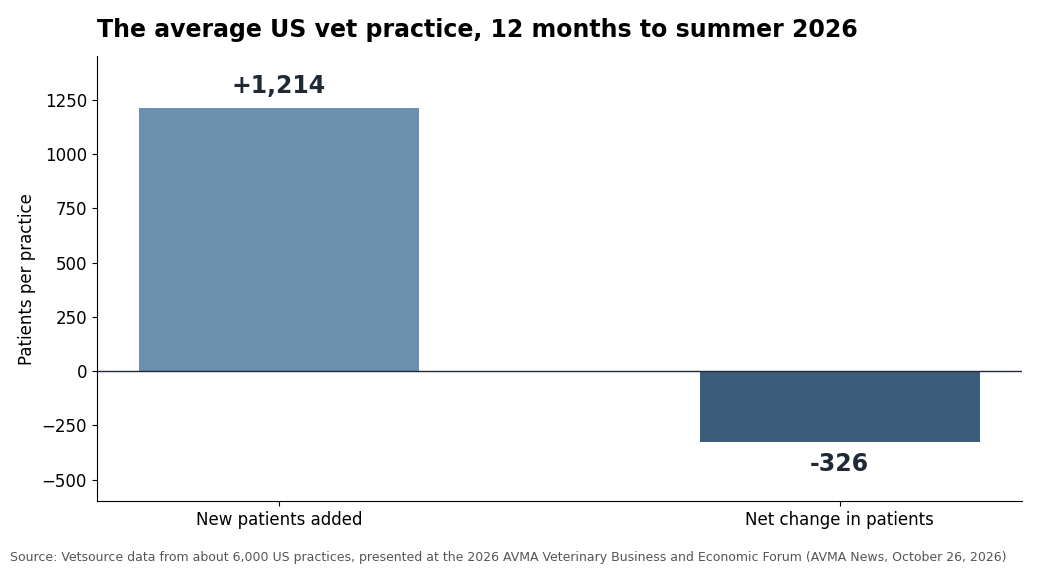
Marketing a veterinary practice like a pro in 2026 means running it as a measured system aimed at the second visit, not a longer list of tactics. Vetsource data reported by the AVMA in October 2026 shows the average US practice added 1,214 new patients in a year and still ended 326 patients down. Own your accounts, count calls and bookings, fix the phone, then keep patients coming back.
Which veterinary marketing tips actually matter in 2026?
The veterinary marketing tips that matter in 2026 are the ones that keep patients coming back, not just the ones that win a first visit. Vetsource data presented at the AVMA's 2026 Veterinary Business and Economic Forum shows the average US practice added 1,214 new patients in the 12 months to summer 2026 and still ended with 326 fewer patients.1 New-patient marketing worked. Retention did not keep up.
Put the two numbers together and roughly 1,540 patients dropped off the average practice's active list in a single year. Visits fell 1.1% over the same period while revenue rose 3.4%, so practices are earning more from fewer visits.1 The CATalyst Council's October 2026 release, based on Vetsource data from 6,595 practices, put the year-on-year fall in clinical visits at 1.9% for July to September.2
So marketing your veterinary practice like a pro is not a longer list of tactics. It is running marketing as a system that follows each patient from the first call to the second visit. Six habits separate the clinics doing that from the clinics buying more first visits to replace the patients they lose.
| The common habit | What a pro does instead | Why it matters in 2026 |
|---|---|---|
| An agency or old web designer holds the logins | The clinic owns every account | You cannot check what you cannot open |
| Judges marketing by clicks and likes | Counts calls, bookings and new patients | AI summaries cut clicks, not demand |
| Buys ads to fix a slow month | Fixes the profile and the phone first | Ads land on whatever is already broken |
| Markets only to strangers | Plans the second visit at the first | Lost patients outnumbered new ones |
| Runs a staff review contest | Asks every client, with nothing offered | Google and the FTC both police reviews |
| Checks results when something feels off | Reviews six numbers on a fixed day | Small leaks are cheap to fix early |
Each habit below is one row of that table. If you want the individual tactics ranked by cost instead, start with our list of 12 veterinary clinic marketing ideas, ranked by the problem they fix.
Tip 1: Own every account your clinic's marketing runs on
An independent veterinary clinic should be the owner, not a guest, on every account its marketing depends on: the Google Business Profile, the domain, the website, Google Analytics, the ad accounts and the call-tracking numbers. Ownership comes first because every other habit depends on it. A clinic that cannot open its own data cannot check whether its marketing is working, or take that data with it when a vendor changes.
Agencies and web designers often set accounts up under their own logins because it is quicker on the day. That is harmless until the relationship ends. Then the clinic finds it cannot change its own holiday hours, see last year's call history or move its domain without the old vendor's help.
Check these this week, from your own logins rather than a vendor's report:
- The clinic is primary owner of the Google Business Profile, and any agency is added as a manager.
- The domain is registered in the clinic's name, with renewal billed to a clinic card.
- The Google Analytics 4 property belongs to a clinic account, with the agency added as a user.
- The Google Ads and Meta ad accounts are in the clinic's name, and the agency has access to them rather than the other way round.
- The call-tracking numbers can be kept or moved if you change provider.
- Someone at the clinic holds an admin login to the website itself.
Ownership is the first of the five promises a vet marketing agency should put in writing, and it is the easiest one to check.
Tip 2: Count calls and bookings, because clicks are shrinking
A veterinary clinic should judge its marketing by calls answered, online bookings and new patients seen, not by website clicks, impressions or likes. Clicks are a weakening signal. Pew Research Center found in 2025 that Google users clicked a traditional search result on 8% of visits when an AI summary appeared, against 15% when one did not.3 Demand can hold steady while clicks fall.
Pew also found that users ended their browsing session on 26% of search pages with an AI summary, against 16% of pages without one.3 For a vet clinic, that means a website traffic report can drop while the phone is fine, or look healthy while the phone goes quiet. The number that tells you which is the number of calls and bookings, tied to the channel that produced them.
A tracking setup that answers the question, in order:
- Give each channel its own call-tracking number, so the Google Business Profile, Google Ads, the website and Meta ads each get credit for their own calls and no call is counted twice.
- Record calls, with whatever disclosure your state requires, and listen to ten of them every month.
- Mark online bookings, form submissions and taps on your phone number as key events in Google Analytics 4, the name Google now uses for the actions that matter most to a business.4
- Match tracked calls and bookings against new-patient records in your practice management software once a month.
Tracking is the step most clinics skip, and it is the step that makes everything else accountable. GrowDVM has driven over $10M in tracked pipeline for clinic clients, and the word doing the work in that sentence is tracked. Without recorded calls and booking events, any agency's results figure, ours included, would be a guess.
Tip 3: Fix the Google profile and the phone before you buy ads
A veterinary clinic should fix its Google Business Profile and its phone handling before it spends on ads, because paid traffic lands on both. Google says local results are based mainly on relevance, distance and prominence, and that there is no way to request or pay for a better local ranking.5 Ads buy a sponsored slot. They do not repair a thin profile or a phone that rings out.
Relevance is the part a clinic controls most directly. Google's own guidance says businesses with complete and accurate information are more likely to show up in local results, and that more reviews and positive ratings can help local ranking.5 Every service you offer, real hours including holidays, the right primary category and recent photos all feed it.
The phone is the other half. A pet owner who reaches voicemail during the lunch rush can simply call the next clinic on the list, and no report shows the call you missed unless the line is tracked. Use the table to work out which problem you have before you spend.
| If you see | It usually means | What to do |
|---|---|---|
| Profile views steady, calls falling | Calls going unanswered | Listen to ten recorded calls first |
| Calls ringing out after 5pm and on weekends | No after-hours cover | Route overflow to an answering service |
| Few Maps calls despite a good location | A thin or inaccurate profile | Complete services, hours, category, photos |
| Plenty of calls, flat new patients | Calls answered but not converted | Offer a specific time on every call |
| Strong rating, few new reviews | Nobody is asking | Text every client a direct review link |
If after-hours enquiries are the leak, an AI front desk can answer chat, texts and after-hours contacts so a pet owner's first response does not wait for opening time.
Tip 4: Market for the second visit, not just the first
A veterinary clinic markets for the second visit by planning it before the first visit ends: booking the next appointment, setting the reminder and following up when a patient goes quiet. Vetsource measures this as the bonding rate, the share of new patients who return for a second visit within 18 months.1 A clinic that wins first visits but not second ones pays full acquisition cost for a single appointment.
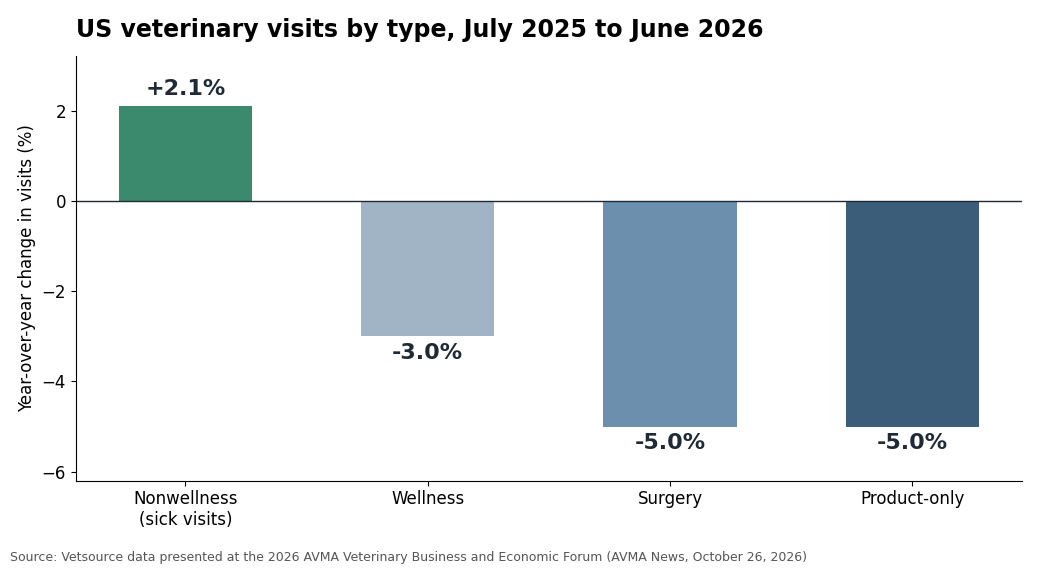
The visit data says where the effort should go. Between July 2025 and June 2026, nonwellness visits rose 2.1% while wellness visits fell 3.0% and surgery visits fell 5.0%, according to Vetsource figures reported by the AVMA.1 Pet owners still come in when a pet is sick. Vetsource's Andrea Ferguson suggested many are putting off vaccines and non-urgent procedures such as dentals, the routine care that used to bring them back between problems.1
The gap between loyal and occasional patients is wide. The top quarter of patients brought in 62% of practice revenue over the same 12 months and made 52% of visits, returning every 44 days on average.1 The other 75% of patients went 230 days between visits.1 That gap is the clearest marketing opportunity in the 2026 data.
Cats are the other opening. CATalyst Council's October 2026 release found feline visits grew 2.7% year on year in the third quarter of 2026 while canine visits fell 3.3%, and that only about 33% of household cats visit a traditional veterinary practice each year.2 A clinic that writes reminders and offers for cat owners is working with that trend instead of against it.
A second-visit routine a front desk can run every month:
- Book the next visit, or set the reminder, before the client leaves the first one.
- End every sick visit with a wellness follow-up date recorded in the patient file.
- Pull a list of patients with no visit in more than 14 months, the point Vetsource treats as lapsing, and contact each owner by the pet's name with one specific reason to come in.1
- Send cat owners reminders written for cats, not reworded dog reminders.
- Count how many of last quarter's new patients have come back, and report it alongside the new-patient count.
How much weight this deserves depends on how your clinic makes its money. Our guide to veterinary marketing strategy by clinic type covers wellness-led, urgent care and seven-day practices separately.
Tip 5: Ask for reviews the way Google and the FTC allow
A veterinary clinic can ask every client for an honest Google review, but it cannot pay for reviews, ask only happy clients or set staff review quotas. Google's Maps content policy bars all three, and the FTC's 2024 rule on consumer reviews lets the agency seek civil penalties against businesses that knowingly buy, fake or suppress reviews.67 Reviews are now regulated marketing, and clinics break the rules without meaning to.
The rule that catches clinics out is the staff contest. Google's policy says businesses should not ask staff to solicit a certain number of reviews, or reviews that mention a specific staff member, and should not pressure clients to leave reviews while on the premises.6 A monthly prize for the technician named in the most reviews breaks two of those at once.
What a vet clinic should stop doing, under one rule or both:
- Offering a discount, a free service or any other reward in exchange for a review, which Google bans whatever the review says.6
- Sending the review link only to clients who scored you well on an internal survey first, which Google calls selectively soliciting positive reviews.6
- Posting reviews written by staff, family or your agency without disclosing the connection, which the FTC's final rule covers as insider reviews.7
- Using legal threats or intimidation to get a negative review removed, which the FTC treats as review suppression.7
- Buying followers or views for the clinic's social accounts, which the FTC rule names as fake indicators of social media influence.7
What stays allowed is the habit that works anyway: ask every client, by text or email after the visit, with a direct link, and reply to every review. Google says replying to reviews shows you value the feedback.5
Tip 6: Review six numbers every month, on the same day
A veterinary clinic owner should review six marketing numbers once a month: new patients, the share of calls answered, online bookings and forms, new Google reviews, lapsed patients won back, and cost per new patient. Together the six show whether the clinic is being found, reached, chosen and kept. Half an hour on a fixed day catches a leak while it is still cheap to fix.
| Number | Where to find it | If it drops, check |
|---|---|---|
| New patients | Practice management software | Calls answered and Maps visibility |
| Calls answered | Phone system or call tracking | Peak-hour staffing and after-hours cover |
| Online bookings and forms | GA4 key events and your booking tool | Broken forms or a slow booking page |
| New Google reviews | Google Business Profile | Whether staff still ask at checkout |
| Lapsed patients won back | Your 14-month lapsed list | Reminder and reactivation messages |
| Cost per new patient | Marketing spend divided by new patients | Which channel's cost rose fastest |
Cost per new patient is the number most clinics cannot produce, because spend and new-patient counts live in different systems. Once tips 1 and 2 are in place it takes minutes. To judge whether the spend side is sensible, compare it with our 2026 veterinary marketing budget benchmarks.
When should you follow these veterinary marketing tips yourself, and when should you hire help?
Most of these veterinary marketing tips cost staff time rather than money, so an independent clinic can run them in house: owning the accounts, asking for reviews, running reminders and reviewing six numbers a month. Hire help when the clinic is buying paid traffic, when nobody on staff owns the monthly review, or when the tracking needed to measure results is missing.
Keep it in house when all three of these are true:
- One person has protected hours each week and the authority to change the profile, the website and the phone script.
- The clinic is not yet spending on Google or Meta ads.
- The six monthly numbers already exist and someone reads them.
Bring in help when any of these is true:
- The clinic is spending on ads without call tracking, so nobody can see what the spend buys.
- The monthly review keeps getting skipped because the people who would run it are seeing patients.
- New-patient numbers are falling and you cannot tell whether the cause is visibility, the phone or retention.
The inconvenient part: an agency cannot fix a phone nobody answers or a reminder list nobody works. If the leak is inside the clinic, the cheapest fix is inside the clinic too. If you are not sure which leak you have, the free GrowDVM audit looks at what is public about your clinic online and shows where the gaps are.
Footnotes
-
AVMA News, "Visit decline slows as patterns for care continue to shift", by Christine Won, reporting Vetsource data from about 6,000 US practices presented at the 2026 AVMA Veterinary Business and Economic Forum, October 26, 2026 https://www.avma.org/news/visit-decline-slows-patterns-care-continue-shift ↩ ↩2 ↩3 ↩4 ↩5 ↩6 ↩7 ↩8
-
CATalyst Council press release via Business Wire, "CATalyst Council Reports Cat Clinical Visits Grow 2.7 Percent as U.S. Veterinary Clinical Visits Fall 1.9 Percent", Vetsource data from 6,595 practices, October 13, 2026 https://finance.yahoo.com/healthcare/articles/catalyst-council-reports-cat-clinical-170000292.html ↩ ↩2
-
Pew Research Center, "Google users are less likely to click on links when an AI summary appears in the results", browsing data from 900 US adults in March 2025, July 22, 2025 https://www.pewresearch.org/short-reads/2025/07/22/google-users-are-less-likely-to-click-on-links-when-an-ai-summary-appears-in-the-results/ ↩ ↩2
-
Google Analytics Help, "Conversions vs. key events in Google Analytics", retrieved November 2026 https://support.google.com/analytics/answer/13965727?hl=en ↩
-
Google Business Profile Help, "Tips to improve your local ranking on Google", retrieved November 2026 https://support.google.com/business/answer/7091?hl=en ↩ ↩2 ↩3
-
Google Maps User Generated Content Policy, "Prohibited & restricted content", fake engagement section, retrieved November 2026 https://support.google.com/contributionpolicy/answer/7400114?hl=en ↩ ↩2 ↩3 ↩4
-
Federal Trade Commission, "Federal Trade Commission Announces Final Rule Banning Fake Reviews and Testimonials", press release, August 14, 2024 https://www.ftc.gov/news-events/news/press-releases/2024/08/federal-trade-commission-announces-final-rule-banning-fake-reviews-testimonials ↩ ↩2 ↩3 ↩4
Frequently asked questions.
How many new patients does the average vet practice add each year?
The average US veterinary practice added 1,214 new patients in the 12 months to summer 2026, according to Vetsource data from about 6,000 practices reported by the AVMA. The same average practice still ended the year 326 patients down, because more existing patients lapsed or left than new patients arrived.
What is a bonding rate for a veterinary practice?
A veterinary bonding rate is the percentage of new patients who return for a second visit within 18 months of their first, as Vetsource defines it. A vet practice with a high bonding rate keeps the new patients its marketing wins. Vetsource data reported by the AVMA in 2026 found practices in higher-income areas bond more of their new patients.
How much revenue comes from a vet clinic's most loyal patients?
The most loyal quarter of patients brought in 62% of US veterinary practice revenue in the 12 months to summer 2026, according to Vetsource data presented at the AVMA's 2026 economic forum. That top quarter also made 52% of visits and returned every 44 days on average, while the other 75% of patients went 230 days between visits.
Can a vet clinic run a staff contest for Google reviews?
A veterinary clinic should not run a staff contest for Google reviews. Google's Maps content policy says businesses should not ask staff to collect a set number of reviews, or reviews that name a staff member. A vet clinic can still ask every client for an honest Google review, as long as nothing is offered in return.
Are fake or paid reviews illegal for a veterinary clinic?
Fake reviews, and reviews bought with incentives tied to positive sentiment, are banned for veterinary clinics under the FTC rule on consumer reviews and testimonials finalized in August 2024. The rule lets the FTC seek civil penalties against businesses that knowingly break it. It also covers undisclosed reviews from staff and threats used to remove negative reviews.
Can a vet clinic pay Google for a higher Maps ranking?
A veterinary clinic cannot pay Google for a higher ranking in local Maps results. Google states there is no way to request or pay for a better local ranking, which is based mainly on relevance, distance and prominence. Google Ads can buy a vet clinic a sponsored placement, which is separate from the unpaid local ranking.