The right veterinary marketing strategy depends on how a clinic operates, and with US vet visits down 3.1% in 2025 the fit matters. Urgent care clinics win on Google Maps and fast phone answers, wellness clinics on reminders and clear prices, and five-day clinics on after-hours booking, which drew 41% of Vetstoria's online bookings. In-home practices grow through referrals, and new clinics belong on Google 90 days before opening.
What is the right veterinary marketing strategy for your clinic type?
The right veterinary marketing strategy for a clinic depends on three operating facts: when the doors are open, what kind of visit the clinic sells, and whether someone answers the phone when a pet owner calls. An urgent care clinic, a wellness clinic, a five-day practice and an in-home euthanasia service should fund different channels, because their clients find them at different moments.
The fit matters more in 2026. Vetsource found that US veterinary visits fell 3.1% in 2025, the third straight annual decline, in data from 6,451 practices published in April 2026.1 Fewer visits means a generic plan wastes more of its budget.
The decline is uneven. Today's Veterinary Business reported in February 2026 that roughly a quarter of practices still grew visits in 2025, and that sick visits rose 1% while wellness visits fell 3.8%.2 Demand is shifting between visit types, so your clinic type decides where the money goes.
Use the table to find where your veterinary marketing strategy should start.
| If you run | Pet owners usually find you | Fund this first | Common mistake |
|---|---|---|---|
| Urgent or same-day care | Searching right now with a sick pet | Google Maps, call-focused search ads, fast phone answers | Saying "urgent care" without saying what you treat |
| A wellness-focused clinic | Comparing vaccine and checkup prices | Published prices, reminders, local SEO | Discounts that bring one-visit clients |
| A clinic open 7 days | On weekends, when their own vet is closed | Correct weekend hours, weekend ad spend | Promoting weekend slots you can't staff |
| A clinic open 5 days | Booking online at night and on weekends | Online booking, after-hours call capture | Paying for weekend clicks nobody answers |
| In-home euthanasia | Through a referral, days before the decision | Referral relationships, a service-area profile | Ads and retargeting aimed at grieving families |
| A new clinic | On Google, up to 90 days before opening | Profile, website and booking before day one | Starting marketing the week the doors open |
Most clinics are a blend of two rows. A five-day practice that holds same-day slots for sick pets runs two playbooks, and its budget should split roughly the way its revenue does. For the total, start with the 2026 benchmarks on how much a vet clinic should spend on marketing.
How should an urgent care or same-day vet clinic market itself?
An urgent care or same-day vet clinic should build its veterinary marketing strategy around the moment a pet owner searches with a sick or injured animal: a complete Google Business Profile, call-focused search ads and a phone answered within a few rings. Those searches are urgent, so the clinic that appears first, says what it treats and answers fast is best placed to win the visit.
Same-day demand is holding up better than routine care: Vetsource data reported by Today's Veterinary Business showed sick visits up 1% in 2025, the only visit type in that breakdown that grew.2
Veterinary urgent care is outpatient treatment for conditions that are urgent but not emergent, painful enough to need prompt care but not usually serious enough for hospitalization, as AVMA News described it in 2023.3 The same report noted a fair amount of confusion about the term, partly because some practices use it in advertising when it doesn't match what they offer.
Fix that with plain language. List the cases you see, which AVMA's report describes as minor injuries and mild illnesses, and the cases you send to an emergency hospital, on the website, in the profile description and in the ads.
Keep "Urgent Care" out of the Google Business Profile name unless it's on your sign. Google's guidelines say a profile name must reflect the clinic's real-world name and bar service information from it, and adding unnecessary information can get the profile suspended.4 Put urgent care in the services list and description instead.
Choose the primary category with the same care. Whitespark's 2026 survey of 47 local search experts rates the primary Business Profile category as the strongest map pack factor, and Google asks for categories that complete the statement "this business is a", not "this business has a".54 For most urgent care clinics that means Veterinarian or Animal hospital; Emergency veterinarian service belongs to clinics that run a genuine emergency service.
Paid search suits urgent care better than almost any other clinic type, because the search itself is the buying signal. Run Google Ads for veterinary clinics on same-day searches, make a phone call the main action, and schedule spend for the hours your doctors are on the floor.6
The inconvenient part: urgent care clients don't come back on their own. AVMA's report notes that urgent care practices hand long-term care and follow-up back to the pet's primary veterinarian, so a standalone clinic has to win most patients fresh.3 Marketing is a permanent operating cost for that model, not a launch expense.
Two habits lower that cost. Tell every general practice nearby what you treat and when you're open, as an urgent care co-founder quoted by AVMA advises, so they refer clients when they're closed or full.3 And if you're a general practice with same-day slots, book the wellness follow-up before the sick patient leaves.
What marketing works for a wellness clinic when vet visits are falling?
A wellness-focused vet clinic grows in 2026 by keeping existing clients on schedule and making prices easy to find, rather than by buying more first visits. Preventive care is where pet owners are cutting back, so a clinic that wins on reminders, clear pricing and easy booking protects its base while competitors chase a shrinking pool of new clients.
Wellness visits fell 3.8% in 2025, a steeper drop than overall visits, according to Vetsource data reported by Today's Veterinary Business in February 2026.2 Owners are also stretching the gap between appointments.
Vetsource figures presented at the AVMA's October 2024 economic forum put the average gap between visits at 85.8 days in the year to July 2024, up 48% from 57.6 days in the year to July 2021.7 Active patients fell just 1.9% per practice in the same data, so the bigger loss is frequency, not clients walking away.
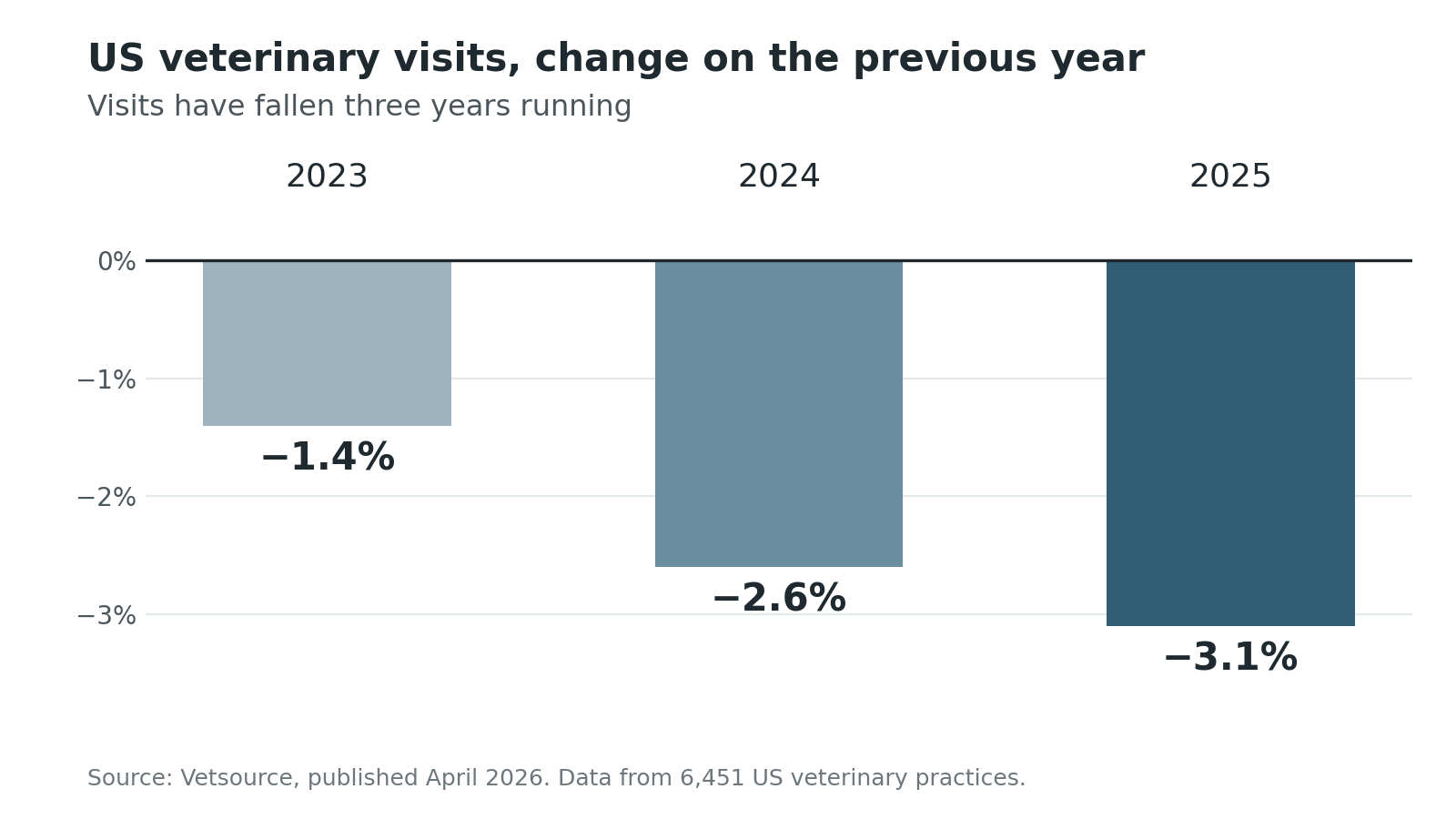
Vetsource, April 2026: visits have fallen three years running across 6,451 US practices.
Cost is the main reason. A PetSmart Charities and Gallup study published in April 2025 found 52% of US pet owners had skipped or declined needed veterinary care in the past year, and 71% of them cited cost.8
Price increases appear to make it worse. Vetsource's April 2026 report found that practices with the steepest two-year rise in the price of a basic wellness visit (27.4%) had the lowest visit growth, while those with smaller rises (24.1%) had the highest.1 That is a correlation rather than proof, but it belongs in your next price review.
What works for a wellness clinic's marketing:
- Published wellness and plan prices let price-sensitive owners qualify themselves before they call.
- Reminders timed to each pet's due date reach the clients most likely to book, because the pets are already yours.
- Local SEO, the work that decides where you appear on Google Maps, keeps the clinic visible when new owners search nearby.
- Meta Ads earn their place announcing wellness plans and puppy and kitten packages to nearby households.
Be careful with discounts. A cheap first exam can fill the book with clients who leave for the next offer, so track second visits within a year before scaling it. For acquisition, see how to approach getting more new patients in 2026.
How should a seven-day vet clinic market its weekend hours?
A vet clinic open seven days a week should sell its weekend availability as the main reason to choose it, because weekend hours are the one thing a five-day competitor can't match. In practice that means correct weekend and holiday hours on Google, ad spend weighted toward Saturday and Sunday, and enough staff to handle the visits the marketing brings in.
Accurate hours come first. Google's Business Profile guidelines ask for regular customer-facing hours, allow special hours for holidays, and list business hours information, such as "Open 24 hours," among the things that must not appear in a profile name.4 A seven-day clinic that is open on a holiday weekend but shows as closed on Google loses exactly the searches its hours were built to win. Update holiday hours weeks ahead, not the night before.
Being open is itself a ranking signal. Whitespark's 2026 survey ranks whether a business is open at the time of the search fifth among map pack factors, so on a Saturday a seven-day clinic competes against fewer open rivals in the map results.5 Hours are one of the four jobs behind pet clinic SEO, and for a seven-day clinic they are the job that pays most.
Weekend demand deserves its own budget line. Google Ads lets a clinic set an ad schedule and adjust bids by day and time, so a seven-day clinic can concentrate spend on Saturday and Sunday instead of spreading it evenly across the week.6
Tell the five-day practices nearby that you're open weekends, too. Those clinics need somewhere to send clients on a Saturday, and a referral from another practice arrives with trust that ads can't buy.
The inconvenient part is capacity. Marketing weekend slots you can't staff produces long waits, and long waits produce bad reviews. BrightLocal's 2026 survey found 31% of consumers will only use a business rated 4.5 stars or higher, up from 17% a year earlier.9 Grow weekend marketing in step with weekend staffing, never ahead of it.
When should a five-day vet clinic run ads after hours?
A five-day vet clinic should run ads outside opening hours only when something can capture the inquiry: online booking that shows real appointment slots, or an after-hours answering service or AI front desk. Without one of those, schedule Google Ads to opening hours, because a Saturday click that reaches voicemail costs the same as a Tuesday click and has nowhere to go.
After-hours demand is real. Vetstoria, an online booking platform used by more than 10,000 clinics, reports that 41% of online bookings made through its system happen after hours, based on its 2025 data.10 Google Ads shows ads all day by default, so a campaign nobody has scheduled is already paying for evening and weekend clicks.6
Ad scheduling is the Google Ads setting that controls which days and hours your ads can appear. Use these signs to decide which side of the line your clinic is on.
| If you see | It usually means | What to do |
|---|---|---|
| A full voicemail every Monday morning | Weekend demand with nowhere to go | Add online booking or an after-hours front desk |
| Saturday ad clicks but no Saturday bookings | You're paying for inquiries you can't take | Schedule ads to opening hours |
| Online bookings arriving overnight | After-hours demand is already captured | Keep ads running into the evening |
| Weekend callers asking where to go | No named emergency or urgent care partner | Name your referral hospital on the site and voicemail |
The threshold is simple. If nothing books or answers after 6 pm on a weekday, the ads should stop at 6 pm too. Once booking or call capture is in place, switch evening and weekend ads back on and judge them on bookings, not clicks.
Scheduling stops paying for clicks you can't take, but it doesn't shrink the bill. Google paces scheduled campaigns toward a monthly spend of 30.4 times the average daily budget, however few days they run, so lower the daily budget as well if the aim is to spend less.6
An AI front desk is software that answers a clinic's calls and messages when nobody on the team can. For a five-day clinic, an AI front desk turns a Saturday inquiry into a Monday appointment instead of a lost lead.
The same ranking factor works against a five-day clinic on weekends, so expect fewer Maps appearances on Saturday and Sunday. Keep the hours on Google exact rather than stretched to look open: Google's guidelines ask for regular customer-facing hours.4
Don't pay for searches you can't serve, such as "vet open Sunday" when you're closed on Sunday. Fund the advantage a five-day clinic does have: continuity with a doctor who knows the pet.
How do you market an in-home pet euthanasia practice without being intrusive?
An in-home pet euthanasia practice is marketed through trust rather than reach: referral relationships with general practices, a Google Business Profile set up as a service-area business, and website content that helps families before the decision rather than during it. Families use the service rarely and under strain, so being easy to find and calm to deal with matters more than being everywhere.
Timing is the clearest lesson from the research. A Companion Animal Euthanasia Training Academy survey of 1,578 pet owners, reported by dvm360 in 2022, found 80% reported a positive experience at home, against 43% in a veterinary hospital.11 The same survey found 66% did when they had a day or more to prepare, against 33% in an emergency.
Families with time to prepare fared better, so the best marketing reaches them before the crisis.
A service-area business is one that serves customers at their own location instead of a storefront, and an in-home practice without a clinic is exactly that. Google's guidelines allow such a practice one Business Profile, ask it to hide its address, and keep its service area within about two hours' drive of base.4
The same guidelines say businesses that work only by appointment shouldn't list opening hours, so put phone availability on the website instead.4
General practices are the natural referral source, because families already trust them at the end of a pet's life. Give every clinic in your service area a one-page referral sheet, a direct line for its front desk and a short note after each visit. Those relationships are worth more than any ad.
Search ads have a place, but a narrow one: high-intent searches such as in-home pet euthanasia plus your town, with plain copy covering service area, what a visit includes, price range and how to reach a person.
Website content does the work before the decision. Pages on judging quality of life, what happens at a home visit, aftercare and cost answer what families research in the days beforehand, and what they now ask AI assistants.
Some standard tactics do harm here. Retargeting, the ads that follow someone around the web after they visit your site, feels intrusive to a grieving household, and so does a review request the next morning. Ask for reviews weeks later, and set any after-hours AI front desk to take details and arrange a callback, not to counsel.
When should a new veterinary clinic start marketing before opening day?
A new veterinary clinic should start marketing at least 90 days before opening day, because that is when Google begins showing a verified Business Profile with a future opening date. Google lets a clinic enter an opening date up to a year ahead, shows the profile from 90 days out, and adds a "Recently opened" tag for 90 days after the doors open.12
One more Google rule shapes the plan: customers can't post reviews or photos on the profile until the clinic officially opens, according to Google's help page on opening dates.12 The pre-opening window is for your own posts, photos and description; the first weeks after opening are for asking every client for a review.
New clinics also open into a tighter market for new clients. Vetsource data presented with the AVMA in October 2024 showed new clients down 8.6% year over year, and AVMA's chief economist noted that new clients make up about 8% of practice revenue.7
The review gap is smaller than it looks. BrightLocal's 2026 survey found 74% of consumers look for reviews written in the last three months.9 Recency narrows the distance between a new clinic that asks every client and an established clinic that stopped asking years ago.
A launch timeline that works for most new clinics:
- Lock the clinic name, phone number and address format, and use them identically everywhere.
- Launch the website, with services, prices, hours and online booking, at least four months before opening.
- Create the Google Business Profile, enter the future opening date and complete verification.
- Post construction photos and opening news to the profile from the 90-day mark.
- Start search and social ads 30 to 60 days out to fill the first weeks of appointments.
- Ask every client for a Google review from day one, and answer every review.
- Push hardest on visibility while the "Recently opened" tag shows for 90 days.
BrightLocal's 2026 survey also found use of ChatGPT and similar tools for local recommendations rose from 6% to 45% in a year.9 A new clinic starts with no reviews or mentions for those tools to find, so publish consistent details everywhere from week one; the wider playbook is in this guide to showing up in Google AI Overviews.
How GrowDVM builds a veterinary marketing strategy for each clinic type
GrowDVM builds a veterinary marketing strategy around how a clinic actually operates, using six services: websites, Google Ads, Meta Ads, local SEO and GEO, social media, and an AI Front Desk. Each clinic type gets a different mix and a different first priority, and every inbound call, form and online booking from the channels GrowDVM runs is tracked and recorded.
GEO, or generative engine optimization, is the work of making a clinic easy for AI answer engines such as ChatGPT and Google's AI Overviews to find and cite. GrowDVM is the only marketing agency built specifically for independently owned vet practices, so the starting point is your hours, visit mix and phone coverage rather than a package.
Here is how that mix usually starts for each of the six clinic types in this guide.
| Clinic type | Start with | Add next | Hold off on |
|---|---|---|---|
| Urgent or same-day care | Google Ads, local SEO and GEO | AI Front Desk for overflow calls | Organic social for growth |
| Wellness-focused | Website pricing pages, local SEO and GEO | Meta Ads for plans and packages | Discount-led first-visit offers |
| Open 7 days | Local SEO and GEO, weekend Google Ads | Social media for weekend updates | Ads that outrun weekend staffing |
| Open 5 days | AI Front Desk, website booking | Google Ads on a set schedule | Weekend ads with nothing to book |
| In-home euthanasia | Website, service-area local SEO | Narrow, high-intent Google Ads | Meta Ads and retargeting |
| New clinic | Website and profile 90 days out | Google Ads and Meta Ads from 60 days out | Print before the basics are live |
Tracking keeps the mix honest. Every call, form and booking from a channel GrowDVM runs is recorded and attributed, which is how GrowDVM can point to over $10M in tracked pipeline for clinic clients instead of a report full of clicks. If an agency can't show you call recordings and booked appointments by channel, you can't tell whether your mix is working.
GrowDVM's offer is straightforward:
GrowDVM guarantees 150 new-patient opportunities in 90 days, or we work free until you hit it. A new-patient opportunity is a prospective client who contacts the clinic through a channel we run: every inbound call, form submission and online booking, tracked and recorded. The guarantee assumes the recommended minimum ad budget and applies to Growth Plan clients.
Volume is the right goal for most clinic types here. For an in-home euthanasia practice it is the wrong one: one strong referral relationship with a busy general practice can matter more than any lead count.
A free marketing audit checks your profile, website and ads against your real hours and visit mix, and shows which row fits your clinic.
Footnotes
-
Vetsource, report on visit trends across 6,451 US practices, published 6 April 2026 https://vetsource.com/blog/turn-declining-visits-into-sustainable-growth/ ↩ ↩2
-
Today's Veterinary Business, "Consumer Strain Reshapes Pet Care", on Vetsource's 2025 data, published 1 February 2026 https://todaysveterinarybusiness.com/pet-care-study-0226/ ↩ ↩2 ↩3
-
AVMA News, "Urgent care clinics starting to enter veterinary profession", published 11 October 2023 https://www.avma.org/news/urgent-care-clinics-starting-enter-veterinary-profession ↩ ↩2 ↩3
-
Google Business Profile Help, business representation guidelines, retrieved October 2026 https://support.google.com/business/answer/3038177 ↩ ↩2 ↩3 ↩4 ↩5 ↩6
-
Whitespark, 2026 Local Search Ranking Factors, survey of 47 local search experts, published 6 November 2025 https://whitespark.ca/local-search-ranking-factors/ ↩ ↩2
-
Google Ads Help, "About ad scheduling", retrieved October 2026 https://support.google.com/google-ads/answer/2404244 ↩ ↩2 ↩3 ↩4
-
AVMA News, "Less foot traffic at veterinary practices spells declining revenue", published 29 October 2024 https://www.avma.org/news/less-foot-traffic-veterinary-practices-spells-declining-revenue ↩ ↩2
-
Gallup and PetSmart Charities, State of Pet Care study of 2,498 US pet owners, published 15 April 2025 https://news.gallup.com/poll/659057/pet-owners-skip-decline-veterinary-care-due-cost.aspx ↩
-
BrightLocal, Local Consumer Review Survey 2026, published 11 February 2026 https://www.brightlocal.com/research/local-consumer-review-survey/ ↩ ↩2 ↩3
-
Vetstoria, homepage statistics from 2025 booking data, retrieved October 2026 https://www.vetstoria.com/ ↩
-
dvm360, CAETA survey of 1,578 pet owners on euthanasia, published 12 August 2022 https://www.dvm360.com/view/how-pet-owners-define-a-good-death- ↩
-
Google Business Profile Help, "Add a business opening date", retrieved October 2026 https://support.google.com/business/answer/9174409 ↩ ↩2
Frequently asked questions.
How early can a new vet clinic appear on Google before opening?
A new veterinary clinic can appear on Google 90 days before its opening date. Google lets the clinic enter an opening date up to a year ahead, shows the verified profile from 90 days out, and adds a Recently opened tag for 90 days after launch. Customers cannot post reviews on the profile until the clinic officially opens.
How does an in-home euthanasia vet appear on Google Maps?
An in-home euthanasia practice appears on Google as a service-area business. Google's guidelines allow one service-area profile for a practice without a storefront, ask for the home address to be hidden, and keep the service area within about two hours' drive. Practices that work only by appointment should not list opening hours.
What share of online vet bookings happen after hours?
About 41% of online veterinary bookings made through Vetstoria happen after hours, based on 2025 data from the booking platform, which more than 10,000 clinics use. For a clinic open five days a week, much of that demand arrives when nobody is at the front desk, so online booking or after-hours call capture matters.
How recent do a vet clinic's Google reviews need to be?
A veterinary clinic's Google reviews should be recent, ideally from the last three months. BrightLocal's 2026 consumer survey found 74% of consumers look for reviews written in that window. Clinics that ask every client for a review keep a steady flow of recent feedback, which counts for more than a large total built up years ago.
What can a vet clinic include in its Google Business Profile name?
A veterinary clinic's Google Business Profile name should be its real-world name, as used on its signage and website. Google's guidelines bar extras such as taglines and business hours, and adding unnecessary words can get a profile suspended. Terms like urgent care or open 7 days belong in services and descriptions instead.