
A trusted vet marketing agency puts five promises in writing: your clinic owns every account, Google's charges are reported apart from the agency's fee, every SEO change is logged, a named strategist answers directly, and replies and urgent alerts have deadlines. That matters because PetDesk's 2026 report found at least 78% of veterinary practices do not track what a new client costs.
What should a trusted vet marketing agency put in writing?
A trusted vet marketing agency puts five promises in writing: your clinic owns every account, Google's charges are reported separately from the agency's fee, every SEO change is logged against data you can open yourself, a named strategist answers you directly, and replies and urgent alerts have deadlines. Each promise can be checked from your own logins, which is the practical difference between an agency that is transparent and one that says it is.
Every agency website uses the same words, and none of them can be tested on a sales call. A promise in the agreement costs the agency something when it is broken, and a promise you can verify yourself does not depend on the agency's report at all. Ask for all five before you sign and again at every renewal.
| What agencies say | What to get in writing | How to check it yourself |
|---|---|---|
| Trusted | Your clinic is primary owner of the Business Profile and owns the ad accounts, domain and tracking numbers | Sign in with owner or admin access, not read-only |
| Transparent | Google's exact charges, the agency fee and results by channel, every month | Match the report to Google's billing and your call log |
| Good at SEO | A dated log of every change, with the reason for it | Compare the log with Search Console |
| Easily accessible | A named strategist with a direct phone line and email | Call on an ordinary Tuesday afternoon |
| Reachable and responsive | Reply times, plus same-day alerts for urgent problems | Time the replies for one month |
These five cover the working relationship after you sign. The screening questions that come before it, including who should hold the owner role on your profile, are in our guide to screening a veterinary marketing agency.
What does a transparent vet marketing agency report every month?
A transparent vet marketing agency reports three numbers every month: what Google charged, listed separately from the agency's fee; what that spend produced, counted as calls, form submissions and bookings by channel; and cost per new client. Cost per new client is total marketing spend, fees included, divided by the number of new clients that spend brought in. It is the one figure that tells you whether the invoice is worth paying.
Google already requires the first number. Under its third-party policy, an agency sharing Google Ads cost data must report the exact amount Google charged, exclusive of its own fees, and must disclose any management fee in writing before your first purchase and on every invoice.1 A single invoice line blending the two does not meet that standard.
The third number is the one most clinics never see. PetDesk's 2026 State of Veterinary Practice Management Report, a survey of 400 veterinary professionals across North America, found that at least 78% of practices do not track client acquisition cost.2 Without it, you are judging the work on clicks and impressions, which are the agency's inputs rather than your results. Our budget benchmarks walk through the cost-per-new-patient math.
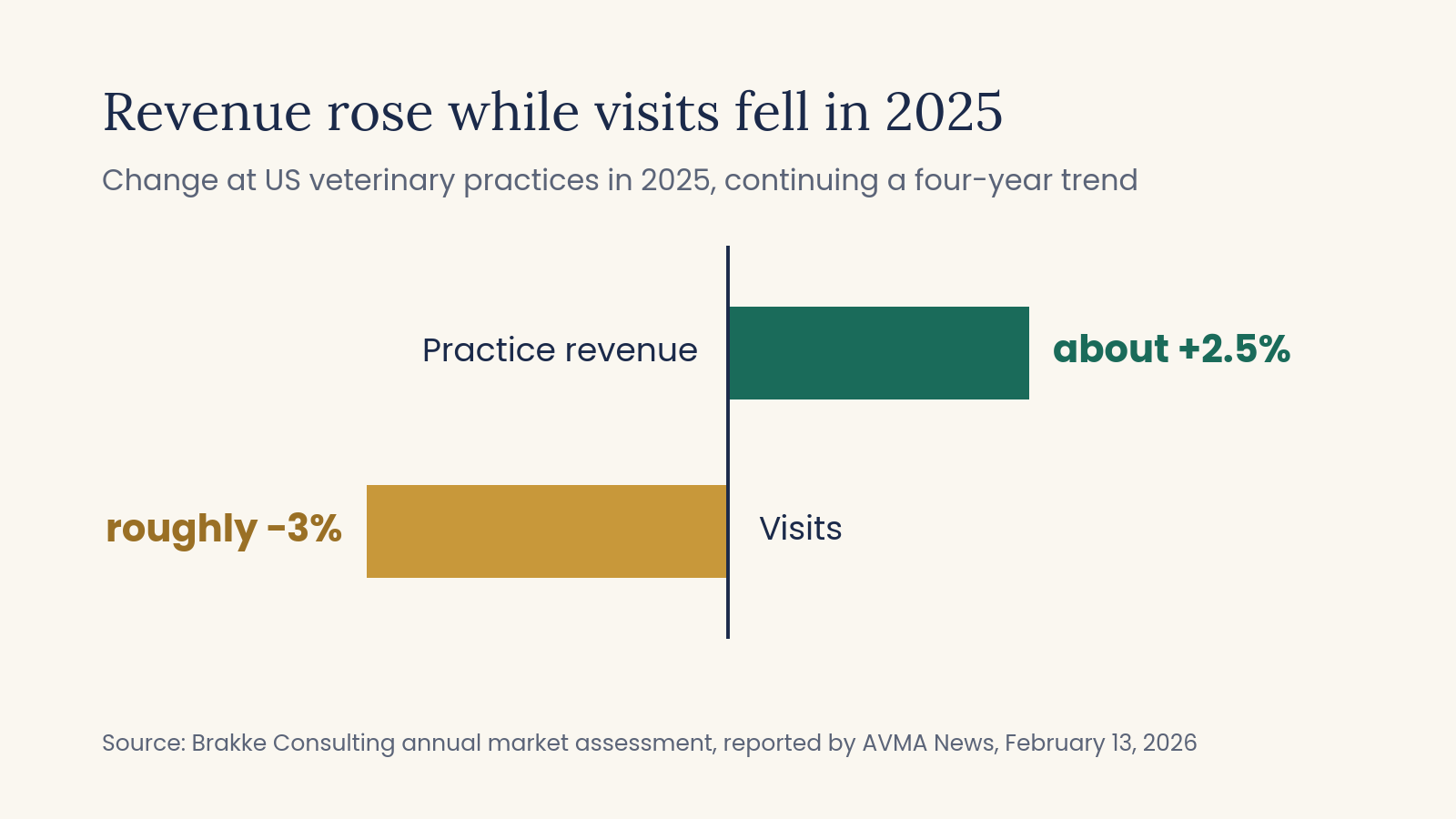
AVMA News reported in February 2026 that, according to Brakke Consulting's annual assessment, US practice revenue rose about 2.5% in 2025 while visits fell roughly 3%, extending a four-year trend.3 A new client you cannot trace to a source is a result you cannot repeat.
Google Business Profile is the free listing that shows your clinic on Google Maps and in local results, and Google says its performance data includes actions from both organic search and Google Ads.4 A report that credits every profile call to SEO may be counting calls your ads paid for. Call tracking, which gives each channel its own phone number, stops the same call being claimed by both the SEO report and the ads report.
Tracking numbers need an owner too. Google's Business Profile guidelines say a profile's phone number must be under the direct control of the business,5 so keep tracking numbers in your clinic's account and your main number on your website and directories.
Who answers when your clinic calls its marketing agency?
A named strategist should answer when your clinic calls its marketing agency: one person who knows your account, reachable by direct phone and email, with a second named person covering holidays and sick days. A shared inbox or ticket form is fine for logging requests. It cannot be the only way in, because whoever picks up a ticket usually knows nothing about your clinic.
The usual failure is the handover. The person who sold you the service is quick and well informed, then disappears after onboarding, and your account passes to someone managing too many others. Ask who your day-to-day contact will be and how many clinics that person runs, then speak to them before you sign.
Google's advice on hiring an SEO makes the same point: ask how you can expect to communicate with the provider, and ask past clients whether it was easy to work with.6 Easy to work with includes plain language. A strategist who cannot explain last month's results in two sentences is either unsure of them or unwilling to say.
Capacity decides how reachable anyone stays, because an agency adding clinics faster than it adds staff gets slower every month, whatever the contract says. GrowDVM takes on 2 to 3 new clinics per month, and any agency should be able to give you its own number without hesitating.
How fast should a vet marketing agency respond, and what should it flag first?
A vet marketing agency should acknowledge routine requests within one business day and act on urgent problems the same business day. Urgent means anything costing your clinic calls right now: a website that is down, a booking form that stops sending, ads running without call tracking, or wrong hours on your Business Profile. Put both response times in the agreement, because a standard that only exists in a sales call cannot be enforced.
Replying is the smaller half of the job. Google's own guidance lists answering your questions among the services a paid Business Profile manager may offer,7 but an agency that is actively responding tells you about a problem before you find it. These alerts belong in writing:
- The agency tells you the same day when your website goes down or a booking form stops sending.
- The agency tells you when calls from paid ads go unanswered, because you are paying for every one of those clicks.
- The agency tells you when your Business Profile hours, phone number or categories change, whoever changed them.
- The agency tells you before the month's ad spend overshoots the agreed budget, not after the invoice arrives.
- The agency tells you when results drop, with its best explanation, before you have to ask.
Unanswered calls are often a staffing problem, not a marketing one. If they cluster after hours, an AI front desk can answer those calls and messages and pass each one to your team.
How can you check an agency's SEO work without asking the agency?
You can check an agency's SEO work with two things you control: a change log and your own Google Search Console access. A change log is a dated record of every edit to your website and Business Profile, with the reason for each. Google Search Console is Google's free tool showing which searches your site appeared in. Google's guidance on hiring an SEO suggests asking whether the provider will share every change it makes to your site, with the reasoning.6
AI search is now checkable the same way. The Generative AI performance report in Search Console shows how often your pages appeared in AI Overviews and AI Mode. Google says it reached all websites on August 31, 2026, though sites with too few AI impressions may see no data.8 An agency selling AI visibility can show you that report instead of a proprietary score.
Google's guide to generative AI search says optimizing for AI features is still SEO, says site owners do not need new AI text files or special markup, and warns that no third-party tool has access to Google's internal ranking or AI systems.9 AEO and GEO, short for answer engine and generative engine optimization, name the same work, so a separate AEO fee on your invoice deserves a direct question.
Google also states that no one can guarantee a #1 ranking, and that advertising with Google has no effect on your site's presence in organic search results.6 For what legitimate AI search work involves, see how vet clinics show up in AI search.
What are the signs an agency is not being straight with you?
The clearest signs an agency is not being straight with your clinic are structural rather than personal: reports you cannot verify, invoices that blend ad spend with fees, results with no calls attached, and replies that only come through a ticket queue. Each has a specific fix, and most take one email. Review tactics are the exception, because they create legal risk for the clinic itself.
In the US, the FTC's Consumer Review Rule bans fake reviews and incentives offered only for positive ones, and when the FTC sent a round of warning letters in December 2025, it put civil penalties at up to $53,088 per violation.10 Google's guidance on hiring an SEO adds that you are responsible for the actions of any company you hire.6 An agency's review shortcut becomes your clinic's liability.
Review gating is the quieter version: a tool that asks clients to rate the visit privately and sends only the happy ones on to Google. Google's Maps content policy prohibits selectively soliciting positive reviews.11
| If you see | It usually means | What to do |
|---|---|---|
| A PDF report and no logins | The data lives in the agency's accounts | Ask for owner or admin access this week |
| One invoice line for ads and fees | Google's charges and the fee are blended | Ask for them separately, as Google's policy requires |
| Rankings and traffic, never calls | Nobody is tracking outcomes | Ask for calls, forms and bookings by channel |
| Replies take days, from whoever is free | No one owns your account | Ask for a named strategist in writing |
| A promise of the #1 spot on Google | A claim Google itself contradicts | Ask what the guarantee actually counts |
| A "how did we do?" screen before the Google link | Review gating, which Google's policy prohibits | Send every client the same review link |
| Reviews you cannot trace to real clients | Possible fake or paid reviews | Stop it in writing today |
If the sticking point is a guarantee, read what a veterinary marketing guarantee can honestly promise before you accept one.
When should you fix the agency relationship, and when should you switch?
Fix the relationship first when the problems are speed and reporting: send your current agency the five promises in writing and give it 60 days to meet them. Switch when the agency will not give your clinic owner access to its own accounts, cannot show calls and bookings by channel after 90 days, or has used review tactics that break FTC rules. Those three are not service gaps. They are how the agency operates.
During the 60 days, log reply times, alerts that arrived before you noticed the problem, and whether each report matched your own logins. That log turns a vague feeling into a decision you can defend.
Leaving is mostly paperwork if your clinic already owns everything, and slow if it does not. Do it in this order:
- Confirm your clinic holds the primary owner role on your Google Business Profile, since only owners can add or remove users and only the primary owner can transfer ownership.12
- Request your Google Ads customer ID in writing, which Google requires agencies to provide on request.1
- Export call recordings, form submissions and the change log while the agency still has access to them.
- Move call-tracking numbers, the domain registration, website hosting, and your Bing Places and Apple Maps listings into the clinic's name.
- Give notice under the contract, and remove the agency's access only after the new team confirms it has everything.
If you want a second opinion on what your current agency is reporting, enter your website for a free marketing audit before you decide either way.
Footnotes
-
Google Advertising Policies Help, "Transparency requirements" (third-party policy), retrieved September 2026 https://support.google.com/adspolicy/answer/16489093 ↩ ↩2
-
PetDesk, 2026 State of Veterinary Practice Management Report, survey of 400 veterinary professionals across North America, retrieved September 2026 https://petdesk.com/state-of-veterinary-practice-management ↩
-
AVMA News, report on Brakke Consulting's annual market assessment, February 13, 2026 https://www.avma.org/news/veterinarians-report-increasing-price-sensitivity-decreasing-visits ↩
-
Google Business Profile Help, "Understand your Business Profile performance and insights," retrieved September 2026 https://support.google.com/business/answer/9918094 ↩
-
Google Business Profile Help, "Guidelines for representing your business on Google," website and phone section, retrieved September 2026 https://support.google.com/business/answer/3038177 ↩
-
Google Search Central, "Do you need an SEO?", last updated June 5, 2026 https://developers.google.com/search/docs/fundamentals/do-i-need-seo ↩ ↩2 ↩3 ↩4
-
Google Business Profile Help, "Tips for working with third parties to manage your Business Profile," retrieved September 2026 https://support.google.com/business/answer/7163406 ↩
-
Search Console Help, "Generative AI performance report," rolled out to all websites August 31, 2026 https://support.google.com/webmasters/answer/16984139 ↩
-
Google Search Central, "Optimizing your website for generative AI features on Google Search," last updated July 10, 2026 https://developers.google.com/search/docs/fundamentals/ai-optimization-guide ↩
-
Federal Trade Commission Business Blog, warning letters under the Consumer Review Rule, December 22, 2025 https://www.ftc.gov/business-guidance/blog/2025/12/warning-letter-or-ten-businesses-comply-ftcs-consumer-review-rule ↩
-
Google Maps User Generated Content Policy Help, "Prohibited and restricted content," fake engagement section, retrieved September 2026 https://support.google.com/contributionpolicy/answer/7400114 ↩
-
Google Business Profile Help, "Manage your Business Profile owners and managers," retrieved September 2026 https://support.google.com/business/answer/3403100 ↩
Frequently asked questions.
How often should a vet marketing agency send a report?
A vet marketing agency should send a written report every month and give the clinic its own logins to check the numbers in between. Google's third-party policy requires agencies that share Google Ads cost data to report the exact amount Google charged, separate from their own fee, and to show any management fee on every invoice.
How quickly should a marketing agency reply to a vet clinic?
A marketing agency working for a vet clinic should acknowledge routine requests within one business day and act on urgent problems, such as a website outage or ads running without call tracking, the same business day. Both response times belong in the written agreement, because a standard that only exists in a sales call cannot be enforced.
Where can a vet clinic see its AI Overviews visibility?
A vet clinic can see its AI Overviews visibility in the Generative AI performance report in Google Search Console, which shows impressions from AI Overviews and AI Mode. Google says it rolled the report out to all websites on August 31, 2026, though a site with too few AI impressions may not see data yet.
What happens if a marketing agency posts fake reviews for my clinic?
Fake reviews posted by a marketing agency put the clinic at risk, not only the agency. In the US, the FTC's Consumer Review Rule bans fake reviews and incentives for positive-only reviews, and in December 2025 the FTC put civil penalties at up to $53,088 per violation. Google also says businesses are responsible for the companies they hire.
What should a vet clinic take back when leaving an agency?
A vet clinic leaving a marketing agency should take back the primary owner role on its Google Business Profile, its Google Ads customer ID, its call-tracking numbers, the domain and hosting logins, call recordings, form submissions and the change log. Google requires agencies to provide the Google Ads customer ID on request, so a refusal is a warning sign.