The most effective veterinary clinic marketing strategies in 2026 fix four jobs in order. Get found on Google, get chosen on reviews, get reached when pet owners call or book, and keep clients from lapsing. Vetsource data shows US visits fell 3.1% in 2025, so clinics grow by winning and keeping households, not by adding tactics.
What are the most effective veterinary clinic marketing strategies in 2026?
The most effective veterinary clinic marketing strategies in 2026 fix four jobs in order: getting found on Google, getting chosen on reviews, getting reached when a pet owner calls or books, and keeping existing clients from lapsing. Each job leaks patients in a different place. A clinic that spends on the first job while the third one leaks pays for attention it never converts.
The order matters more this year because demand is shrinking. Vetsource's January 2026 white paper found US veterinary visits fell 3.1% per practice in 2025, across 6,451 practices, with wellness visits down 3.8%.1 Practices raised service prices 6.57% over the same period, but revenue rose only 5.4% because the number of unique patients fell.1
The clinics still growing are doing it with volume. Vetsource's Sheri Gilmartin told Today's Veterinary Business in February 2026 that roughly 25% of practices still increased visits in 2025, down from 50% in 2024.2
For the digital channels on their own, see our guide to what works in digital marketing for independent vet clinics.
12 veterinary clinic marketing ideas, ranked by the problem they fix
A veterinary clinic marketing plan works when ideas are ranked by which leak they plug and how cheap the fix is, not by how popular the tactic sounds. The twelve ideas below run roughly from cheapest to most expensive. Most independent clinics should finish the first eight before paying for the last four, because paid traffic only works when the profile, reviews and phones it lands on already work.
| Idea | Fixes | Typical cost | Skip it if |
|---|---|---|---|
| 1. Complete your Google Business Profile | Being found | Staff time | Never |
| 2. Ask every client for a review | Being chosen | Staff time | Never |
| 3. Reply to every review by name | Being chosen | Staff time | Never |
| 4. Listen to ten recorded calls a month | Being reached | Staff time | You already score calls |
| 5. Text lapsed clients | Being kept | Staff time | Reminders already reach them |
| 6. Forward-book wellness at checkout | Being kept | Staff time | Never |
| 7. Add real-time online booking | Being reached | Software fee | Your software cannot sync slots |
| 8. One web page per service | Being found | Writer or agency | Rarely |
| 9. After-hours call answering | Being reached | Service fee | You answer late, 7 days |
| 10. Google Ads | Being found | Ad spend plus management | Calls go unanswered |
| 11. Meta Ads | Being found | Ad spend plus management | You need calls this week |
| 12. Organic social posting | Being kept | Staff time or agency | It crowds out ideas 1 to 9 |
Ideas 1 to 6 all use staff time you already pay for, and each makes the paid ideas below it cheaper per new client.
For the paid end, the 2026 benchmarks on what a vet clinic should spend on marketing set out the ranges.
Getting found: Google Business Profile first, ads second
Getting found starts with the Google Business Profile, because Google's local results decide which clinics a nearby pet owner sees first. Google says local ranking rests on relevance, distance and prominence, and states that no business can pay for a better local ranking.3 An independent veterinary clinic controls relevance and prominence directly, and improving both costs staff time rather than ad spend.
Relevance starts with the primary category. Whitespark's 2026 Local Search Ranking Factors survey, published in November 2025, ranks the primary Business Profile category as the strongest factor for Google Maps rankings, and a dedicated website page for each service as the strongest for local organic results.4 Pick the most specific category that fits, such as Veterinarian, Animal hospital or Emergency veterinarian service. Then list every service you offer, keep holiday hours current and add real photos.
Prominence comes from how many websites link to you and how many reviews you have, according to Google's own help page.3
The profile now feeds more than Google. BrightLocal's 2026 Local Consumer Review Survey found 45% of consumers use ChatGPT or similar AI tools for local business recommendations, up from 6% a year earlier.5 Whitespark's experts rank placement on expert "best of" lists and a dedicated page for each service as the top two factors for AI search visibility.4 The same BrightLocal survey found the share of consumers reading reviews on Apple Maps rose from 14% to 27%, so keep your name, address, phone number and hours identical on Google, Apple Maps, Bing and Yelp.5
Distance is the factor you cannot change, so the realistic goal is to win your own radius every time. Our guide to turning vet near me searches into new patients covers that ranking work in detail.
Getting chosen: reviews now filter clinics out before anyone calls
Online reviews now decide whether a veterinary clinic gets considered at all, because pet owners set a minimum rating before they read a word. In BrightLocal's February 2026 survey, 68% of consumers said they would only use a business rated four stars or higher, up from 55% in 2025, and 31% now insist on 4.5 stars or more, up from 17%.5
Volume and freshness carry their own thresholds. The same BrightLocal survey found 47% of consumers will not use a business with fewer than 20 reviews, and 74% only pay attention to reviews written in the last three months.5
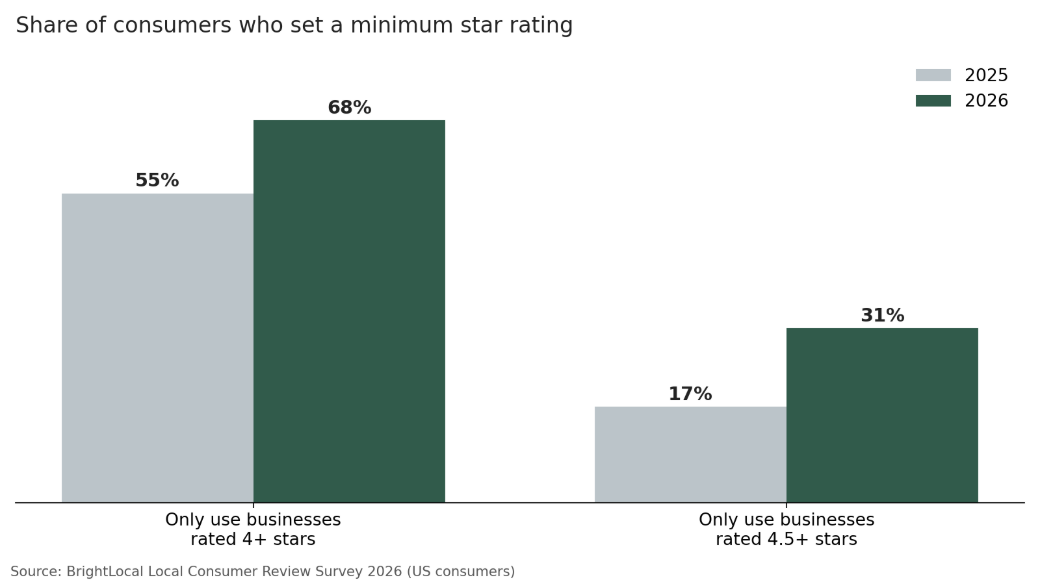
The share of consumers who only use businesses rated 4.5 stars or higher nearly doubled in one year. Source: BrightLocal Local Consumer Review Survey 2026.
The fix for a weak review profile is a habit, not a campaign:
- Ask every client at checkout, in person, not only the ones who seem happy.
- Send the review link by text the same day, while the visit is fresh.
- Reply to every review within a few days, by name, without a template, and keep the pet's medical details out of public replies.
- Count new reviews each month, and treat a month with none as a problem.
Replies are worth the time. BrightLocal found 80% of consumers are likely to use a business that responds to all of its reviews.5
Two rules matter more than the rest. Google's contribution policy bans offering payment, discounts or free services in exchange for a review, and classifies the result as fake engagement.6 A free nail trim for a five-star review is not a clever idea. It is a policy violation with your clinic's name on it.
The same policy bars businesses from discouraging negative reviews or selectively soliciting positive ones.6 A review tool that asks clients how their visit went and only sends the happy ones to Google breaks that rule, which is why step 1 says every client.
Getting reached: a third of booking attempts never become an appointment
A veterinary clinic's phones and booking path are marketing, because every paid click and every review ends in a call or a booking attempt. When researchers posed as dog owners and phoned more than 5,000 randomly chosen practices in six states in early 2025, they secured an appointment only 67% of the time, according to an Ohio State University summary of the JAVMA study.7
Not every lost booking is fixable: in almost 4% of calls the practice was not accepting new patients, and callers who did book waited an average of 6.4 days.7 But the failed calls usually failed at the phone, because callers could not reach staff or were left on hold too long.7 A clinic that loses callers that way is paying to create demand and then turning it away.
Pet owners notice. Vetstoria's March 2026 survey of 2,000 pet owners in the UK and Australia found difficulty getting appointments was the largest non-cost reason people considered switching vets, cited by 19%.8 The sample is not American, so read it as a direction rather than a US benchmark.
The cheapest test is ten recorded calls. Listen for ring time, whether a new client was offered a specific time, and what happened after 5pm. If calls ring out at lunch or after hours, an AI front desk or an answering service closes the gap without another hire.
Getting kept: lapsed clients are the cheapest visits to win back
A lapsed client is the cheapest visit a veterinary clinic can win, because the pet is already in your records and the owner already chose you once. Vetsource defines a lapsing patient as one with no transactions in more than 14 months.1 With wellness visits down 3.8% in 2025, most clinics now hold more lapsed patients than they did two years ago, and few market to them on purpose.
Price is part of why clients drift. In the same white paper, practices with the strongest visit growth charged an average of $250.39 for a basic canine wellness visit, against $274.22 at practices with the weakest growth, a 9% gap.1 That is not an argument for cutting prices. It is an argument for giving a lapsed client a clear reason and a clear price.
A lapsed-client reactivation run takes an afternoon:
- Pull every patient with no visit in the last 14 to 24 months from your practice management software.
- Remove deceased pets and clients who have moved, so nobody receives a painful message.
- Text each owner using the pet's name and one specific due item, such as a vaccine or dental check.
- Include a direct booking link and the name of a person to call.
- Follow up once by email a week later, then stop.
Then close the leak at the source: forward-book the next wellness visit at checkout.
Which veterinary marketing ideas should you skip?
Skip any veterinary marketing idea that adds attention before the clinic can convert it. Paid ads come after the profile, reviews and phones work, and discounts for reviews break Google's rules. Daily social posting rarely moves bookings for a clinic whose phone rings out at lunch.
The line between "fix first" and "spend now" is specific. Run Google Ads when three things are true: your Google Business Profile is complete, your rating is at least four stars (the bar 68% of consumers now set), and your recorded calls show someone answering. Our breakdown of Google Ads costs and when they work for vet clinics covers the rest.
Other ideas that usually disappoint:
- Flyers and mailers with no tracking number cannot tell you whether they worked.
- A rebrand rarely fixes a visits problem, because pet owners choose on reviews and access.
- New-client discounts tend to attract one-visit shoppers rather than households.
None of these is always wrong. Each belongs after the four jobs, not in place of them.
How do you know which veterinary clinic marketing strategies are working?
Veterinary clinic marketing strategies are working when you can count what each one produced in calls, form fills and bookings, by source, every month. A clinic that cannot say how many new clients came from Google Maps last month cannot tell which idea to fund next, and often cuts the one that was working.
Use this table to read your own numbers:
| If you see | It usually means | What to do |
|---|---|---|
| Profile views falling month on month | Google matches you to fewer searches | Check the primary category, services list and hours |
| Profile views up, calls flat | A conversion problem, not visibility | Listen to recorded calls before spending more |
| Calls up, bookings flat | Callers are not offered a time | End every new-client call with a time |
| Rating below 4.0 | Most searchers filter you out | Fix the review habit before paid spend |
| Bookings steady, active patients falling | Clients are lapsing | Run a reactivation and forward-book |
Tracking also makes an agency's claims checkable. GrowDVM reports over $10M in tracked pipeline for clinic clients, and the word doing the work in that sentence is "tracked". Whoever runs your marketing, ask for the raw call and booking list.
To see where your own clinic leaks first, the free marketing audit checks your profile, reviews and website against these four jobs.
Footnotes
-
Vetsource, "Turning trends into opportunities: Insights to meet client expectations and build loyalty in 2026", white paper based on 6,451 US practices, January 2026 https://assets.vetsource.com/m/792028a0a8071385/original/Turning-trends-into-opportunities-white-paper.pdf ↩ ↩2 ↩3 ↩4
-
Today's Veterinary Business, "Consumer Strain Reshapes Pet Care", report on Vetsource 2025 visit data including comments from Sheri Gilmartin, published 1 February 2026 https://todaysveterinarybusiness.com/pet-care-study-0226/ ↩
-
Google Business Profile Help, "Tips to improve your local ranking on Google", retrieved October 2026 https://support.google.com/business/answer/7091?hl=en ↩ ↩2
-
Whitespark, 2026 Local Search Ranking Factors, survey of 47 local search experts, published 6 November 2025 https://whitespark.ca/local-search-ranking-factors/ ↩ ↩2
-
BrightLocal, Local Consumer Review Survey 2026, panel of 1,002 US adults, published 11 February 2026 https://www.brightlocal.com/research/local-consumer-review-survey/ ↩ ↩2 ↩3 ↩4 ↩5
-
Google Maps User Contributed Content Policy, "Fake engagement" and "Rating manipulation" sections, retrieved October 2026 https://support.google.com/contributionpolicy/answer/7400114?hl=en ↩ ↩2
-
The Ohio State University, summary of a JAVMA secret-shopper study of more than 5,000 veterinary practices in six states, October 30, 2025 https://news.osu.edu/checkup-time-for-fido-wait-might-be-longer-in-the-country/ ↩ ↩2 ↩3
-
Vetstoria, "Veterinary Industry Trends 2026: What 2,000 Pet Owners Told Us", survey of UK and Australian pet owners conducted by 7Insights, published 13 March 2026 https://www.vetstoria.com/blog/veterinary-industry-trends-statistics/ ↩
Frequently asked questions.
How many Google reviews does a vet clinic need in 2026?
A veterinary clinic should aim for at least 20 Google reviews, with new ones arriving every month. BrightLocal's 2026 survey found 47% of consumers will not use a business with fewer than 20 reviews, and 74% only pay attention to reviews written in the last three months.
How long before a vet clinic client counts as lapsed?
A veterinary client counts as lapsing after more than 14 months with no visit or purchase, the definition Vetsource uses in its 2026 industry data. A vet clinic should start reactivation outreach at that point, by text, using the pet's name and one specific due item.
What does Google say about vet clinics rewarding clients for reviews?
Google's contribution policy prohibits any business, including a veterinary clinic, from offering payment, discounts, free goods or free services in exchange for a review, and treats those reviews as fake engagement. It also bars asking only happy clients. A vet clinic can ask every client for an honest review, as long as nothing is offered in return.
Do pet owners use ChatGPT to find a local vet?
Pet owners increasingly ask AI tools to recommend local businesses such as vet clinics. BrightLocal's 2026 survey found 45% of US consumers use ChatGPT or similar tools for local recommendations, up from 6% a year earlier. Those tools weigh more than a Google profile, including best-of lists, service pages and mentions on industry websites.
How often does a call to a vet clinic get an appointment?
A caller asking a US veterinary practice for an appointment got one only 67% of the time in a 2025 secret-shopper study of more than 5,000 practices in six states, published in JAVMA. Failed calls usually never reached staff or sat on hold too long, and callers who booked waited an average of 6.4 days.