Vet near me searches turn into clinic income when three things line up. Google shows your clinic, pet owners trust your reviews enough to pick it, and someone answers when they call. That matters more in 2026, because Vetsource data shows US veterinary visits fell 3.1% in 2025 and price increases are no longer covering the gap.
How do vet near me searches turn into clinic income?
Vet near me searches turn into clinic income in three steps. Google shows the clinic in the local map results, the pet owner trusts its reviews enough to pick it, and someone answers when they call or book. An independent veterinary clinic that wins all three adds new households without leaning on price increases. A clinic that loses any one of the three pays for the visibility and never sees the patient.
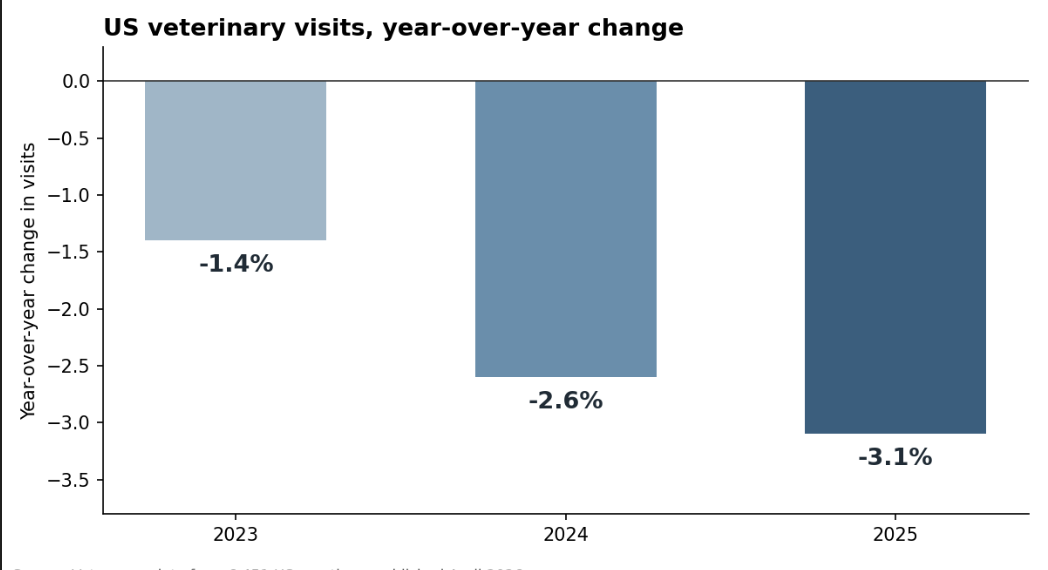
The timing matters. Vetsource's analysis of 6,451 US practices found that US veterinary visits fell 3.1% in 2025, according to Vetsource's April 2026 report, after declines of 1.4% in 2023 and 2.6% in 2024.1 The same data links the steepest wellness price increases to the weakest visit growth, so raising fees is running out of road.
Not every clinic is shrinking. Vetsource's Sheri Gilmartin told Today's Veterinary Business in February 2026 that roughly 25% of practices increased visits in 2025, down from 50% in 2024.2 The same article reports that the practices with the most visit growth raised wellness and parasiticide prices the least. They grew by adding clients, and adding clients starts with being the clinic a pet owner finds, picks and reaches.
If new-client volume is the problem you're solving, our guide to getting more new patients at your veterinary clinic covers every channel. This post covers the search itself, and the money attached to it.
How does Google rank clinics for vet near me searches?
Google ranks clinics for vet near me searches on three factors it names publicly: relevance, distance and prominence. Relevance is how well a Google Business Profile matches what someone searched. Distance is how far the clinic is from the searcher. Prominence is how well known the clinic is, and Google says more reviews and positive ratings help. Google also states that no business can pay for a better local ranking.3
Distance is the factor you cannot change, and it is the one agency pitches tend to skip. A veterinary clinic will not outrank a competitor two streets from the searcher on distance alone. The realistic goal is to win your own radius every time, then stretch it with relevance and prominence.
Relevance is where most independent clinics leave visibility on the table. Whitespark's 2026 Local Search Ranking Factors survey, published in November 2025, ranks the primary Business Profile category as the strongest factor for Google Maps rankings, and a dedicated website page for each service as the strongest for local organic results.4 A profile with the right primary category, accurate hours, every service you actually offer, and a page for each of those services gets matched to more of what pet owners type: "cat dental cleaning", "puppy vaccines open Saturday", "emergency vet open now".
The phrase "near me" itself does not belong in your profile. Google's guidelines say a Business Profile name must reflect the business's real-world name, list "Equinox near SOHO" as a name that is not allowed, and warn that extra words in the name can get a profile suspended.5 Google already knows where the searcher is standing. Your job is to make the profile match what they need.
Prominence comes from reviews and from other websites linking to your clinic, according to Google's own Business Profile help page.3 It builds slowly and compounds, which makes it the part worth managing every month. That ongoing work is what GrowDVM's local SEO and GEO service covers.
What do pet owners check before they pick a vet near them?
Pet owners check reviews before they pick a vet near them, and the bar rose sharply in 2026. BrightLocal's Local Consumer Review Survey 2026, based on 1,002 US adults, found that 97% of consumers read reviews for local businesses, 47% won't use a business with fewer than 20 reviews, and 74% only care about reviews written in the last three months.6
The same 2026 survey shows how fast expectations moved:
- Star ratings carry more weight than a year ago, with 31% of consumers only using businesses rated 4.5 stars or higher, up from 17% in 2025.
- Four stars has become the floor for most people, since 68% will only use a business with four stars or more.
- Silence costs customers, because 42% say they are unlikely to use a business that never replies to its reviews.
- Asking works, as 83% of people who were asked to leave a review in the past year went on to leave one.
For a veterinary clinic, this changes the job. A 4.7 rating built mostly from reviews written in 2023 reads as stale to three in four pet owners. Review requests need to go out after every visit, to every client, not in a once-a-year push.
The other shift is where pet owners ask. BrightLocal found that use of ChatGPT and other AI tools for local business recommendations rose from 6% to 45% in a year, making AI the third most used source after Google and Facebook, while the share of consumers reading reviews on Apple Maps rose from 14% to 27%.6 Those tools read listings beyond Google, so keep your clinic's name, address, phone number and hours identical on Apple Maps, Bing and Yelp. Our breakdown of how veterinary clinics show up in Google AI Overviews covers what changes when the answer comes from AI.
What is a new client from a vet near me search worth?
A new dog-owning household is worth about $580 a year in veterinary spending, and a cat-owning household about $433, based on preliminary 2024 data from the AVMA Pet Ownership and Demographics Sourcebook.7 Those are national averages across all owners, including households that skip the vet entirely. That makes them a cautious starting point when you estimate what a client from a vet near me search adds to your clinic's income.
Run it for your own clinic. Count the new households that searches bring in each month, multiply by 12, then multiply by your average first-year client value from your practice management software, or by the AVMA averages if you do not have one yet. The households you keep spend it again the year after, so the first-year figure understates what each search is worth.
The people searching are worth catching for a specific reason. The AVMA's 2024 data shows 86.8% of dog owners already have a regular veterinarian.7 So a pet owner typing "vet near me" is usually in a moment of change: a new puppy, a recent move, an urgent problem, or a falling-out with their current clinic. Whoever handles that first visit well has a real chance of keeping them.
The demand is not shrinking. US pet owners spent $41.0 billion on veterinary care and product sales in 2025, and 95 million US households own a pet, according to the American Pet Products Association's 2026 State of the Industry report.8 The question is which clinic that spending reaches. To set a budget that matches the value of a client, see how much a vet clinic should spend on marketing.
Where do veterinary clinics lose patients after a vet near me search?
Veterinary clinics lose most search patients after the search, not during it. A pet owner who finds the clinic still has to like the reviews, land on a website that answers their question, and reach a person or a booking page. BrightLocal's 2026 survey found 54% of consumers visit a business's website after reading positive reviews, so a slow or vague clinic website breaks the chain one step before the call.6
Use this table to work out which step is costing your clinic patients:
| If you see | It usually means | What to do |
|---|---|---|
| Profile views rising, calls flat | The listing is seen but not chosen | Compare your rating, review recency and photos with the top three clinics |
| Calls rising, new bookings flat | Calls are missed or handled badly | Listen to ten call recordings before spending more |
| Calls ringing out at lunch or after 5pm | No cover when pet owners search | Route overflow to an answering service or AI front desk |
| Website visits high, few form fills | The site makes booking hard | Put the phone number and booking link at the top of every service page |
| Few views for service searches | Weak relevance signals | Add services and categories to the profile, and build service pages |
| Different hours or phone numbers on Apple Maps, Bing or Yelp | Pet owners and AI tools see conflicting details | Make every listing match the Business Profile exactly |
The phone is where search patients are easiest to lose. A missed call from a pet owner who has never visited often goes to the next clinic on the map, and nobody at your clinic ever knows it happened. If calls go unanswered after hours or during busy stretches, an AI front desk answers, books and routes them, so a search you earned does not ring out.
What should a vet clinic fix first to rank locally?
An independent veterinary clinic should fix its Google Business Profile first, its reviews second and its website third, because that is the order a pet owner meets them. The steps below fit into about a month with an hour or two a week, and none of them require paying for ads. Each one strengthens relevance or prominence, the two local ranking factors a clinic can actually move.
- Claim and verify the Google Business Profile, and confirm the name, address, phone number and hours match the website, Apple Maps, Bing and Yelp exactly.
- Choose the most specific primary category that fits, such as Veterinarian, Animal hospital or Emergency veterinarian service, add secondary categories, and list every service the clinic actually offers.
- Upload recent photos of the building, the team and the exam rooms, taken on the premises.
- Ask every client for a review after each visit, by text or email, with a direct link to the review form, and never only the clients you expect to be happy.
- Reply to every review, positive and negative, within a few days and in your own words rather than a template.
- Build one website page per core service, each with the phone number and booking link near the top.
- Track every call, form and booking, so you can tell which searches produced paying patients.
Step 4 has a rule behind it. Google's content policy bars businesses from discouraging negative reviews or selectively soliciting positive ones, so a review tool that screens clients first breaks the rules on your own profile.9 The full version of each step is in our guide to the four jobs of pet clinic SEO.
The last step is the one clinics skip, and it is the one that tells you whether the first six worked. At Del Paso Veterinary in Sacramento, a Business Profile reset and on-page SEO brought 38% more Google Business Profile interactions in the first full month, and tracking is the only reason anyone knows that.
When is veterinary SEO enough, and when do you need Google Ads too?
Veterinary SEO is enough when a clinic is established, already appears in the map results for its own neighborhood, and wants steady growth over the next year. Google Ads earn their place when a clinic needs patients this month, when it is new and has few reviews, or when it wants to reach pet owners just outside the radius where distance lets it rank. Most growing independent clinics end up using both, in that order.
| Veterinary SEO | Google Ads | |
|---|---|---|
| Speed | Builds over months | Live within days |
| Cost per click | None | Every click is paid |
| When you stop | Most gains hold | Leads stop |
| Best for | Established clinics, long-term growth | New clinics, urgent volume, wider radius |
Paying for ads does not change a clinic's organic map ranking. Google states that there is no way to pay for a better local ranking, and ads appear as separate labeled placements.3 Our guide to Google Ads for vet clinics covers when the spend pays off.
Here is the inconvenient part. If your profile has 12 reviews and a 3.9 rating, ads send more pet owners to a listing that loses them. Fix the reviews first. If the reviews are strong and you still need volume faster than SEO can deliver, that is when ads pay their way.
What does GrowDVM do for independent veterinary clinics?
GrowDVM is the only marketing agency built specifically for independently owned vet practices, and its work covers every step from the search to the booked visit. Local SEO and GEO gets the clinic found in map results and AI answers. Veterinary website design turns visits into calls and bookings. Google Ads and Meta Ads add volume when it's needed, social media keeps the clinic visible between visits, and the AI front desk answers when the team can't.
Every call, form submission and online booking runs through tracking, which is why GrowDVM reports results as over $10M in tracked pipeline for clinic clients rather than a traffic chart. For clinics that want a commitment behind the work:
GrowDVM guarantees 150 new-patient opportunities in 90 days, or we work free until you hit it. A new-patient opportunity is a prospective client who contacts the clinic through a channel we run: every inbound call, form submission and online booking, tracked and recorded. The guarantee assumes the recommended minimum ad budget and applies to Growth Plan clients.
To see where your clinic stands today, run the free GrowDVM marketing audit. It checks the profile, review and website signals that decide whether vet near me searches end at your front desk or at the clinic down the road.
Footnotes
-
Vetsource, "How veterinary practices can turn declining visits into sustainable growth", data from 6,451 US practices, April 2026 https://vetsource.com/blog/turn-declining-visits-into-sustainable-growth/ ↩
-
Today's Veterinary Business, "Consumer Strain Reshapes Pet Care", published 1 February 2026 https://todaysveterinarybusiness.com/pet-care-study-0226/ ↩
-
Google Business Profile Help, "Tips to improve your local ranking on Google", retrieved October 2026 https://support.google.com/business/answer/7091?hl=en ↩ ↩2 ↩3
-
Whitespark, 2026 Local Search Ranking Factors, survey of local search experts, published 6 November 2025 https://whitespark.ca/local-search-ranking-factors/ ↩
-
Google Business Profile Help, "Guidelines for representing your business on Google", retrieved October 2026 https://support.google.com/business/answer/3038177 ↩
-
BrightLocal, Local Consumer Review Survey 2026, panel of 1,002 US adults, published 11 February 2026 https://www.brightlocal.com/research/local-consumer-review-survey/ ↩ ↩2 ↩3
-
AVMA News, "Pet population continues to increase while pet spending declines", preliminary 2024 AVMA Pet Ownership and Demographics Sourcebook data, published 10 October 2024 https://www.avma.org/news/pet-population-continues-increase-while-pet-spending-declines ↩ ↩2
-
American Pet Products Association, Industry Trends and Stats, from the 2026 State of the Industry Report, retrieved October 2026 https://americanpetproducts.org/industry-trends-and-stats ↩
-
Google Maps user contributed content policy, "Prohibited and restricted content", rating manipulation section, retrieved October 2026 https://support.google.com/contributionpolicy/answer/7400114 ↩
Frequently asked questions.
How many Google reviews does a vet clinic need?
A veterinary clinic should aim for at least 20 Google reviews, because BrightLocal's 2026 survey found 47% of consumers won't use a business with fewer than 20. Recency matters as much as count, since 74% of consumers only care about reviews written in the last three months.
Can a vet clinic pay Google to rank higher locally?
No veterinary clinic can pay Google for a higher local ranking in the map results. Google says local ranking rests on relevance, distance and prominence, and that there is no way to request or pay for a better position. Google Ads appear separately as labeled ads and stop showing when the spending stops.
Should a vet clinic add near me to its Google Business Profile name?
A vet clinic should not add near me, a city or a service to its Google Business Profile name. Google's guidelines say the name must match the clinic's real-world name, give "near SOHO" as an example of a name that is not allowed, and warn that breaking the rule can get the profile suspended.
What is a new dog-owning client worth to a vet clinic?
A new dog-owning household is worth about $580 a year in veterinary spending to a vet clinic, and a cat-owning household about $433, according to preliminary 2024 AVMA Pet Ownership and Demographics data. Those national averages include owners who skip the vet entirely, so they are a cautious starting point for your own numbers.
Do pet owners use ChatGPT to find local businesses?
Pet owners increasingly use ChatGPT and other AI tools to find local businesses such as veterinary clinics. BrightLocal's 2026 survey of US consumers found AI tool use for local business recommendations rose from 6% to 45% in a year, making AI the third most used source after Google and Facebook.
How long does veterinary SEO take to show results?
Veterinary SEO should be judged after a full quarter of tracked calls, forms and bookings. Fixes to a clinic's Business Profile categories, services and hours tend to register first, while gains from reviews and links build over several months. Distance to the searcher never changes, and Google publishes no fixed timeline.