A veterinarian SEO agency does the same four jobs as any local SEO provider, but makes vet-specific calls a generalist misses, such as whether each doctor gets a Google Business Profile, where the word specialist is allowed, who signs pet health pages and how online bookings are tracked. Whitespark's 2026 survey ranks the primary Business Profile category as the top Google Maps factor.
What does a veterinarian SEO agency do that a general SEO agency doesn't?
A veterinarian SEO agency does the same four jobs as any local SEO provider: the Google Business Profile, reviews, service pages and the technical health of the website. The difference is a handful of veterinary calls inside those jobs that a general SEO agency has no reason to know, from how many Business Profiles a multi-doctor clinic should run to who is allowed to be called a specialist.
Every agency that ranks for this search says it specializes in vets. Few spell out what that changes in the work. Veterinarian SEO services should get five calls right:
- The Business Profile is structured around how the clinic actually runs, including whether each doctor gets a profile and whether any department gets its own.
- Service pages use only the words the AVMA allows, so a general practice never calls its vets specialists, and nothing implies emergency cover the clinic does not have.
- Pet health pages are written or reviewed by a named veterinarian, not produced in bulk.
- Online bookings are tracked all the way into the booking tool, so the clinic can see which ones came from search.
- The structured data is typed so Google reads the clinic as both a local business and a vet's office.
None of these is exotic. Each is a place where a competent generalist makes a choice that works for a dentist or a plumber and is wrong for a vet clinic. Google's guidance on hiring an SEO, updated in June 2026, suggests asking "What's your experience in my industry?"1 These five calls are what a good answer sounds like. Pricing and contract terms sit in our guide to what veterinary SEO services should include and cost.
Should every vet at your clinic have their own Google Business Profile?
Most single-location vet clinics should run one Google Business Profile for the clinic rather than one per veterinarian. Google's guidelines treat doctors as individual practitioners who may hold their own profile, but say a practitioner who is the only public-facing one at a branded location should share the organization's profile. Separate vet profiles split the reviews pet owners judge the clinic on.
For a one-doctor practice, Google's Business Profile guidelines settle it: one shared profile, named for the brand and then the practitioner.2 For a clinic with four or five vets, separate profiles are allowed, but every review left on a doctor's profile is one the clinic profile does not get.
That cost is rising. BrightLocal's 2026 survey found 74% of consumers look for reviews written in the last three months, and 31% will only use a business rated 4.5 stars or higher, up from 17% in 2025.3 Split a quarter's reviews across five doctors and none of the profiles looks current.
Departments are the exception. Google allows separate profiles for public-facing hospital departments that operate as distinct entities, each with its own name.2 An urgent care service with its own hours and phone line can qualify. A dental suite down the corridor cannot.
Categories call for the same restraint. Google asks for the fewest categories that describe the core business, and Whitespark's 2026 Local Search Ranking Factors survey of 47 experts ranks the primary Business Profile category as the number one factor for Google Maps rankings.4
The profile now feeds AI answers too. Ask Maps, launched in Google Maps in March 2026, answers conversational questions from information on over 300 million places.5 The basics of running the profile are in the four jobs of pet clinic SEO.
Which words should a vet clinic website never use for SEO?
A vet clinic website should never call a veterinarian a specialist unless that vet is currently board-certified. The AVMA's ethics principles reserve the word specialist for veterinarians board-certified by a recognized specialty organization, and AVMA guidance calls the terms board eligible and board qualified misleading. A general SEO writer chasing searches like dog dermatologist near me tends to reach for exactly those words.
The AVMA's guidelines on identifying board-certified veterinarians are blunt: a vet is either board-certified or has no board credentials.6 The searches that tempt the wording are real, though. A general practice can rank for them honestly by describing what it treats, skin allergies in dogs and cats, and naming the specialist it refers complex cases to.
A clinic with a board-certified surgeon on staff has a different trap. AVMA guidance says a specialist who lists other services in an advertisement should word it so those services do not read as specialties too.6
Emergency is the other word to handle carefully. A clinic that takes urgent walk-ins by day is not an emergency hospital at 2am, and Google's guidelines ask for regular customer-facing hours.2 A page or profile that implies otherwise sends a frightened owner to a locked door. State boards can add rules of their own, and what a vet website can claim under the FTC is covered in our guide to veterinary website design.
Who should sign the pet health pages on a vet clinic website?
A named veterinarian should write or review every pet health page on a vet clinic website, and the page should say so. Google's helpful content guidance, updated in October 2026, asks whether pages carry a byline where one might be expected, and says that on sensitive topics its systems give even more weight to content with strong E-E-A-T.
E-E-A-T is Google's shorthand for experience, expertise, authoritativeness and trustworthiness, and the same page says trust matters most of the four.7 An unsigned pet health article on the site of a clinic employing several vets wastes the clinic's strongest signal.
A general SEO agency's content process is built for volume: a writer, a keyword list and a calendar. For a vet clinic, that produces posts nobody at the practice has read. Google's spam policies, updated in August 2026, list using generative AI tools to generate many pages without adding value for users as scaled content abuse.8
The fix is cheap. One vet reads each page before it goes live, the page names them, and the clinic publishes less. AI search does not change the rule: Google's AI optimization guide, updated in July 2026, says optimizing for generative AI search is still SEO, and that sites need no special files or markup to appear in Google Search.9
How can you tell whether your vet SEO is being done by a specialist?
You can tell whether vet SEO is being done by someone who knows veterinary practices by checking six things on your own Business Profile and website, and none of them needs agency access. Each is a choice a generalist makes because it works for other local businesses. Each has a fix that takes an afternoon, not a new contract.
| If you see | It usually means | What to do |
|---|---|---|
| A Business Profile for each vet, each with a few reviews | Practitioner profiles were created without a plan | Ask for reviews on the clinic profile, and decide which doctors need one |
| "Specialist" or "board eligible" on a general practice's pages | The writer does not know the AVMA wording | Describe the condition treated, and name the referral specialist |
| Emergency in the profile or page titles, with no after-hours cover | The wording was picked for search volume | Remove it, and say where to go after hours |
| Pet health posts with no author | The content was written without a vet | Add a named veterinarian as reviewer, or take the post down |
| Online bookings missing from the monthly report | The booking tool runs on another domain, untracked | Set up cross-domain measurement or the tool's own conversion events |
| Schema typed only as VeterinaryCare | The markup is a vet type, not a local business type | List both VeterinaryCare and LocalBusiness |
If three or more rows describe your clinic, the problem is not effort. Whoever is doing the work has not done it for a vet clinic before.
Which technical details are specific to vet clinic websites?
Two technical details are specific to vet clinic websites: online booking that cannot be traced back to search, and structured data typed as a vet's office but not as a local business. Both stay invisible until someone asks which bookings came from Google, or checks how the clinic's markup is typed.
When an online booking tool runs on its vendor's own domain, Google Analytics loses the thread. Google's help page on cross-domain measurement says that without it, new cookies are created for each domain, so a single visit is recorded as two users and two sessions.10 The booking then arrives with no record of the search that started it.
Most practices are not measuring this at all. PetDesk's 2026 State of Veterinary Practice Management Report, a survey of 400 veterinary professionals, found that at least 78% of practices do not track client acquisition cost.11 A veterinarian SEO agency should set up booking and call tracking in the first month, before it reports anything. GrowDVM's veterinary SEO services start with call and website tracking for that reason.
Structured data has a quieter quirk. Schema.org lists VeterinaryCare under MedicalOrganization rather than LocalBusiness.12 Google's local business guidance, updated in September 2026, asks for the most specific LocalBusiness subtype and accepts several types listed as an array.13
So a vet clinic's markup should name both types. It is a ten-minute fix, not a package.
What did a Business Profile reset do for one Sacramento clinic?
Del Paso Veterinary, an independent Sacramento clinic offering same-day appointments, came to GrowDVM in February 2026 with a Google Business Profile that was not turning searches into calls. GrowDVM reset the profile's categories, services, photos and posts, moved same-day appointments to the top of the website, and set up call and website tracking in the same month.
In March 2026, the first full month after the SEO went live, Del Paso had 38% more Google Business Profile interactions than in February. Within three months, direction requests were roughly 70% above baseline. The growth was sustained beyond the first 90 days, holding through spring rather than peaking once.
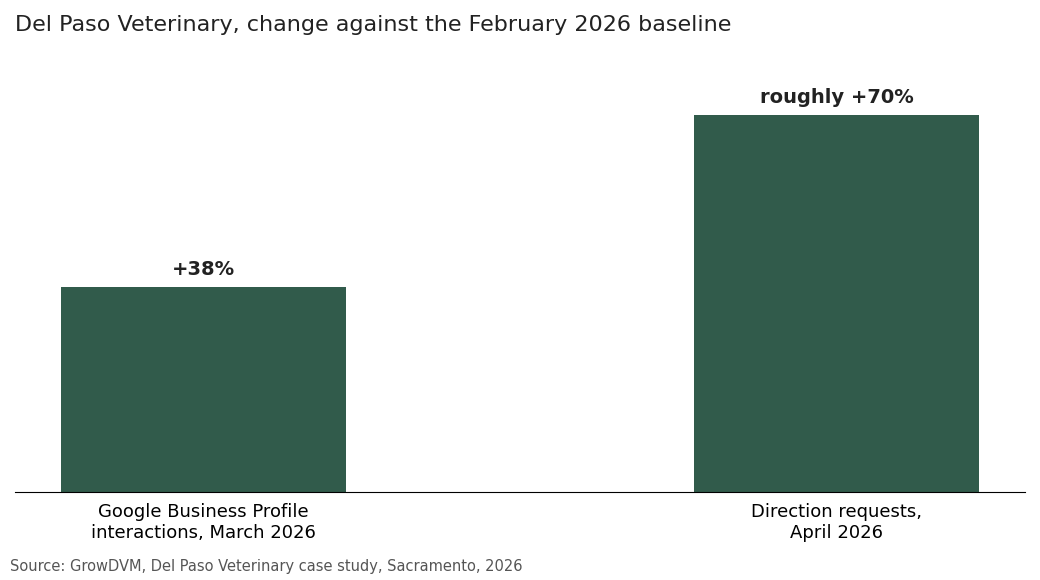
The order mattered as much as the work. The profile came first because it fills the map results a pet owner taps before reaching any website, and tracking came second so every later change could be judged on calls and directions rather than rankings. The month-by-month detail is in the Del Paso case study.
When is a general SEO agency enough, and when do you need a veterinarian SEO agency?
A general SEO agency is enough when the job is purely technical, such as a site migration or a page speed fix, or when someone at the clinic already knows the veterinary rules and only needs hands. A veterinarian SEO agency earns its fee when the work touches the Business Profile structure, pet health content, or any page using the words specialist or emergency.
Hire for veterinary experience when one of these is true:
- The clinic has several doctors, an urgent care service or more than one location, so the profile structure is a real decision.
- The plan includes pet health content at a volume no vet at the practice has time to write.
- The practice has a board-certified vet on staff, or refers out often, so the wording on service pages carries risk.
- The clinic needs to see online bookings, not only calls, tied back to search.
Whichever you hire, ask for a walk-through of your own profile and website before any quote: which doctors have profiles, which pages use the word specialist, and whether online bookings are tracked. A free visibility audit covers the same ground before anyone asks you to sign.
Footnotes
-
Google Search Central, "Do you need an SEO?", last updated 5 June 2026 https://developers.google.com/search/docs/fundamentals/do-i-need-seo ↩
-
Google Business Profile Help, "Guidelines for representing your business on Google", retrieved October 2026 https://support.google.com/business/answer/3038177 ↩ ↩2 ↩3
-
BrightLocal, Local Consumer Review Survey 2026, panel of 1,002 US adults, published 11 February 2026 https://www.brightlocal.com/research/local-consumer-review-survey/ ↩
-
Whitespark, 2026 Local Search Ranking Factors, survey of 47 local search experts, published 6 November 2025 https://whitespark.ca/local-search-ranking-factors/ ↩
-
Google, "Ask Maps and Immersive Navigation: New AI features in Google Maps", Miriam Daniel, published 12 March 2026 https://blog.google/products-and-platforms/products/maps/ask-maps-immersive-navigation/ ↩
-
AVMA, "Guidelines on the identification of board-certified veterinarians", quoting the AVMA Principles of Veterinary Medical Ethics, retrieved October 2026 https://www.avma.org/resources-tools/avma-policies/avma-guidelines-identification-board-certified-veterinarians ↩ ↩2
-
Google Search Central, "Creating helpful, reliable, people-first content", last updated 5 October 2026 https://developers.google.com/search/docs/fundamentals/creating-helpful-content ↩
-
Google Search Central, "Spam policies for Google web search", last updated 28 August 2026 https://developers.google.com/search/docs/essentials/spam-policies ↩
-
Google Search Central, "Google's Guide to Optimizing for Generative AI Features on Google Search", last updated 10 July 2026 https://developers.google.com/search/docs/fundamentals/ai-optimization-guide ↩
-
Google Analytics Help, "Set up cross-domain measurement", retrieved October 2026 https://support.google.com/analytics/answer/10071811 ↩
-
PetDesk, 2026 State of Veterinary Practice Management Report, survey of 400 veterinary professionals in North America, retrieved October 2026 https://petdesk.com/state-of-veterinary-practice-management ↩
-
Schema.org, "VeterinaryCare" type definition, retrieved October 2026 https://schema.org/VeterinaryCare ↩
-
Google Search Central, "Local business (LocalBusiness) structured data", last updated 8 September 2026 https://developers.google.com/search/docs/appearance/structured-data/local-business ↩
Frequently asked questions.
How long does vet SEO take to show results for a clinic?
Vet SEO can show early movement in the first full month when the Google Business Profile is the main problem. Del Paso Veterinary in Sacramento saw 38% more profile interactions in its first full month after SEO went live, against a February 2026 baseline. Service pages and review volume build more slowly, over several months.
Can a general practice vet clinic call its vets specialists?
A general practice vet clinic should not call its veterinarians specialists unless they are currently board-certified. The AVMA reserves the word specialist for veterinarians board-certified by a recognized veterinary specialty organization, and calls the terms board eligible and board qualified misleading. A general practice can describe the conditions it treats and name the specialist it refers to.
Can a vet clinic list itself as an emergency vet on Google?
A vet clinic should only present itself as an emergency vet on Google if it can see emergencies during the hours it lists. Google's Business Profile guidelines ask for regular customer-facing hours, and a profile that suggests after-hours emergency care sends a frightened pet owner to a clinic with the lights off.
Does a vet clinic need VeterinaryCare schema to appear in AI search?
A vet clinic does not need VeterinaryCare schema, or any special markup, to appear in Google's AI search features, according to Google's AI optimization guide updated in July 2026. VeterinaryCare is still worth using alongside LocalBusiness, because schema.org places VeterinaryCare outside the LocalBusiness types that Google's local business guidance asks for.
What should a veterinarian SEO agency track for a vet clinic?
A veterinarian SEO agency should track calls, form submissions and online bookings from search, by channel, for every vet clinic it works with. Online bookings need cross-domain measurement when the booking tool runs on another domain. PetDesk's 2026 report found at least 78% of veterinary practices do not track client acquisition cost.