Veterinary Google Ads management cost comes down to hours of specialist time. Clutch's 2026 pricing guide puts US and Canadian Google Ads work at $100 to $149 an hour, so a $300 monthly fee buys two to three hours and $1,000 buys roughly seven to ten. Compare agencies on all-in cost per lead, with the fee included, not on the fee alone.
What does veterinary Google Ads management cost in 2026?
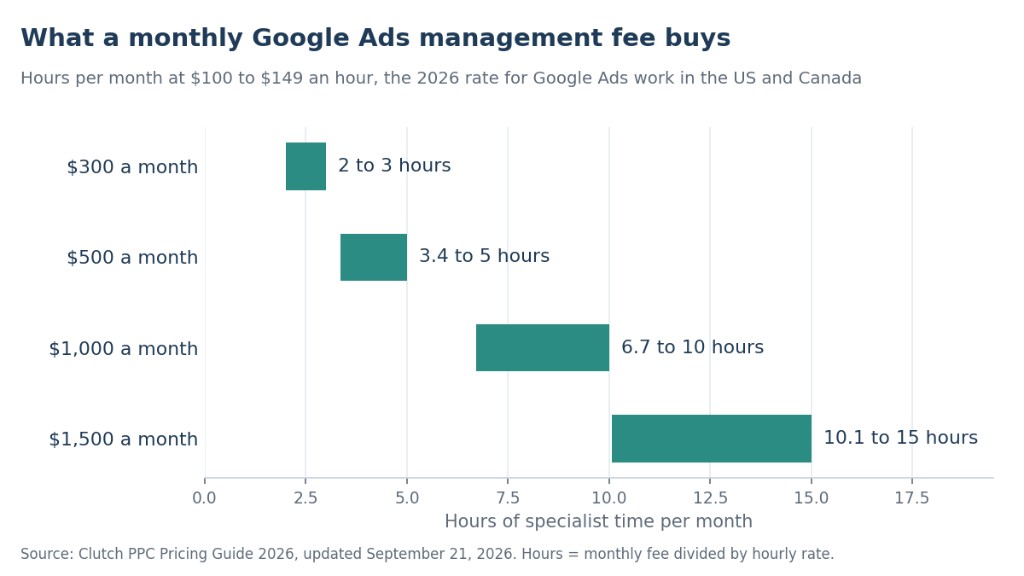
Veterinary Google Ads management cost is a price for specialist time, billed on top of what Google charges for the clicks. Clutch's 2026 PPC pricing guide puts Google Ads work in the US and Canada at $100 to $149 an hour, so a $300 monthly management fee buys two to three hours of work and a $1,000 fee buys roughly seven to ten.
Two to three hours a month is roughly 30 to 40 minutes a week. That covers a dashboard check and a monthly report. It does not stretch to reading every search that triggered your ads, rewriting losing ads and checking that calls are counted across wellness, dental and urgent care campaigns.
The fee is one of two invoices. Google bills the clicks separately, and our breakdown of what Google Ads clicks and leads cost a vet clinic in 2026 covers that side. The agency's invoice decides how well the other one is spent.
Why does one agency quote $300 a month and another $1,000?
A $300 quote and a $1,000 quote for the same veterinary clinic's Google Ads usually describe two different jobs. Setup is the one-time build of campaigns, keywords, ads and conversion tracking. Management is the recurring work after launch: reading search terms, adding negative keywords, testing ads and checking that leads are counted.
Two to three hours a month can keep a finished build running, but not do the second job across several services. In clinic terms, setup is the exam and management is the treatment plan and the rechecks.
Hours a management fee buys each month at the $100 to $149 hourly rate in Clutch's 2026 PPC pricing guide.
Where a low fee saves those hours is predictable:
- One campaign template goes into every clinic's account, whatever the city.
- Keywords stay on broad match, Google's default, which can show ads on searches that don't carry the keyword's direct meaning.
- Search terms get checked monthly or not at all, so searches for vet tech jobs or veterans' services keep spending.
- Ads send everyone to the homepage, because a page per service takes hours to build.
- A tap on the phone number counts as a lead, even when the call lasted two seconds.
- Recommendations get accepted in bulk. Auto-apply, an optional setting, can add broad match keywords and expand ads onto Google's search partner sites without anyone reviewing each change.
Two pricing facts explain the rest. A percentage fee on a small account is a small fee: 15% of $2,000 is $300, whatever the account needs. Rates also vary by country, and Clutch's 2026 guide lists India and the Philippines under $25 an hour. A low fee is not proof of low effort, so ask who does the work and how many hours your account gets.
Why do better-built Google Ads accounts pay less per click?
Better-built Google Ads accounts usually pay less per click, because Google weighs ad quality in every auction. Google's ad quality documentation says higher-quality ads typically cost less per click, and that a low-quality ad may pay close to its maximum bid even when competition is light. For a veterinary clinic, ad quality mostly means the ad and the page it opens match what the pet owner searched.
Quality Score is Google's 1 to 10 diagnostic rating of that quality for each keyword, built from expected clickthrough rate, ad relevance and landing page experience. You will often read that Ad Rank equals bid times Quality Score, but Google's help page says Quality Score is not an input in the ad auction at all.
Google does not publish how much cheaper a better ad's clicks are, so be wary of any agency table promising an exact discount. At LocaliQ's 2026 average of $4.06 a click for animals and pets, $2,000 buys about 490 clicks. If weak ads and a homepage landing page push that to $6, the same $2,000 buys about 330.
The fix is the work a low fee skips: an ad group and a landing page for each service, with ads that repeat the service the owner searched for. Landing pages sit with veterinary website design as much as with advertising, so plan the two together.
How to compare veterinary Google Ads management cost between agencies
The fair measure of veterinary Google Ads management cost is all-in cost per lead: the management fee plus the ad spend, divided by the leads the ads produced. Google's guide for businesses working with ad agencies makes the same case, telling advertisers to understand their total cost with partner fees included and to judge their return on it.
Say two veterinary clinics each spend $2,000 a month on clicks, with the same keywords in similar markets. The table is illustrative arithmetic, not client data and not a budget recommendation.
| Measure | Clinic A | Clinic B |
|---|---|---|
| Management fee per month | $300 | $1,000 |
| Ad spend per month | $2,000 | $2,000 |
| Ad cost per lead | $85 | $40 |
| Leads per month | 23 | 50 |
| All-in cost per lead | $100 | $60 |
Clinic B pays $700 more in fees and still buys each lead for $40 less. The gap between an $85 lead and a $40 lead is made of clicks that were never going to book: job searches, owners outside your drive radius, ads running at 2am with nobody on the phones, and existing clients typing your clinic's name to find the number.
For scale, LocaliQ's 2026 benchmarks put the average animals and pets lead at $31.50 in ad spend, against $66.69 across all industries, counting any call, chat, form or email as a lead. Both invoices belong in the same line of your plan, and our 2026 marketing budget benchmarks show what clinics spend in total.
None of this works without honest lead counts, which means call tracking that separates a hang-up from a booking. GrowDVM reports its own results that way, as over $10M in tracked pipeline for clinic clients, and any agency's report should meet the same standard.
What should monthly Google Ads management include for a vet clinic?
Monthly Google Ads management for a veterinary clinic should include a weekly search terms review, new negative keywords, ad tests for each service line, schedules and locations matched to your hours and drive radius, budget pacing, policy checks, and a monthly report on cost per lead. A fee too small to cover those hours pays for upkeep, not management.
The search terms report is Google's list of the actual searches that triggered your ads, and a negative keyword is a word you add so your ads stop showing for searches that contain it. Reading one and updating the other is how an account stops paying for the wrong searches.
Automation has not made that job smaller. Search Engine Land reported in August 2026 that Google is moving Search campaigns on its campaign-level broad match setting onto AI Max, its AI-driven setup for Search, through September 2026. Automated matching still needs someone reading what it paid for.
Veterinary accounts also carry a policy trap of their own. Google requires certification before a US or Canadian campaign can keyword-target prescription animal drug terms, so keywords naming a prescription allergy or heartworm medication will not run without it. A disapproved ad stops producing leads until someone checks.
Hold any agency to this scope in writing. Our Google Ads for veterinary clinics page sets out how GrowDVM runs its campaigns.
What should your clinic ask a Google Ads agency before signing?
Before a veterinary clinic signs with a Google Ads agency, it should ask who owns the account, what counts as a conversion, how often search terms are reviewed, how many accounts the manager runs, and whether the fee is flat or a percentage of spend. Google's third-party policy already requires agencies to disclose management fees in writing before the first purchase and on every invoice, and to report Google's costs apart from their own fees.
Ownership matters most because it is the hardest thing to fix later. In Google Ads, only Admin users can grant access, change access levels and unlink an agency's manager account, the umbrella login agencies use to run client accounts. Google's advertiser guide says an agency must set up a separate account for each client, and its policy requires agencies to hand over your customer ID on request.
Leaving without the account costs data, not ad quality: Google says moving the same ads and keywords into another account does not change their ad quality. What you lose is history, including the conversion data that Smart Bidding, Google's automated bidding, learns from. As of September 2026, Google says Smart Bidding can take up to around 50 conversions or three conversion cycles to calibrate, and past conversion data shortens that.
| If the agency says | It usually means | What to do |
|---|---|---|
| "We build the account in our login" | You may leave without your history | Get Admin access in writing first |
| "A conversion is a click on your number" | Two-second calls count as wins | Ask for call tracking tied to bookings |
| "We check search terms monthly" | Wrong searches spend for weeks | Ask for weekly reviews |
| "Ads go to your homepage" | You pay more per click for a weaker page | Ask for a page per service |
| "Our fee is 15% of spend" | The fee grows with spend, not leads | Ask what it buys in hours |
Some agencies lead with a guarantee instead of answers. Read what a veterinary marketing guarantee should actually promise before you sign.
When is a $300 Google Ads management fee enough for a vet clinic?
A $300 Google Ads management fee can be enough for a single-location veterinary clinic running one or two campaigns in a small market with few competing clinics. The test is arithmetic. Divide the difference between two agencies' fees by what a lead costs you today, all in, and the answer is how many extra leads a month the pricier agency must deliver just to break even.
Take a clinic paying $300 a month with an all-in cost per lead of $100 and 23 leads a month. A $1,000 agency must deliver at least 7 more leads a month to break even: $700 divided by $100, a 30% lift. If your area produces only a handful of relevant searches a day, that lift may not exist, and the $300 fee is the right buy.
The balance tips the other way as spend, service lines and competition grow. The fee difference stays fixed while wasted clicks tend to rise with spend, so the same $700 is earned back faster in a busier account.
Either way, judge the agency on all-in cost per new client. The cheapest fee and the cheapest lead are different numbers, and only one of them appears on the invoice. For a second opinion on your own setup, start with a free clinic marketing audit.
Frequently asked questions.
How much should a veterinary clinic pay for Google Ads management?
A veterinary clinic's Google Ads management fee buys specialist time, which Clutch's 2026 pricing guide puts at $100 to $149 an hour in the US and Canada. At that rate, $300 a month buys two to three hours and $1,000 buys roughly seven to ten. The right fee is the one with the lowest all-in cost per lead.
How long after an agency switch do a clinic's Google Ads settle?
A veterinary clinic's Google Ads can take up to around 50 conversions or three conversion cycles to settle after a new agency changes the bidding, according to Google's Smart Bidding guidance. Keeping the existing account shortens that, because past conversion data helps automated bidding calibrate. A brand new account starts with no history to learn from.
Why do some vet marketing agencies charge a percentage of ad spend?
Some veterinary marketing agencies charge a percentage of ad spend because the fee grows automatically with a clinic's budget and is simple to quote. The drawback is that the agency earns more when the clinic spends more, whether or not new clients follow. On a small account, a percentage also produces a fee too small to fund much work.
What is a good cost per lead for veterinary Google Ads?
Veterinary clinics fall in the animals and pets category of LocaliQ's 2026 search advertising benchmarks, which averaged $31.50 per lead against $66.69 across all industries, counting any call, chat, form or email as a lead. A clinic should also track its all-in cost per lead, which adds the agency fee, and its cost per booked appointment.
Should a veterinary clinic own its Google Ads account?
A veterinary clinic should own its Google Ads account and hold Admin access, because only Admin users can grant access, change access levels and unlink an agency's manager account. Google's guidance also says an agency must set up a separate account for each client and give the clinic its customer ID when asked.
What must a Google Ads agency disclose to a vet clinic?
Google's third-party policy requires a Google Ads agency to tell a veterinary clinic about any management fee in writing before the first purchase and on every invoice. When the agency shares cost data, it must report Google's charges apart from its own fees, and it must give the clinic its Google Ads customer ID on request.